
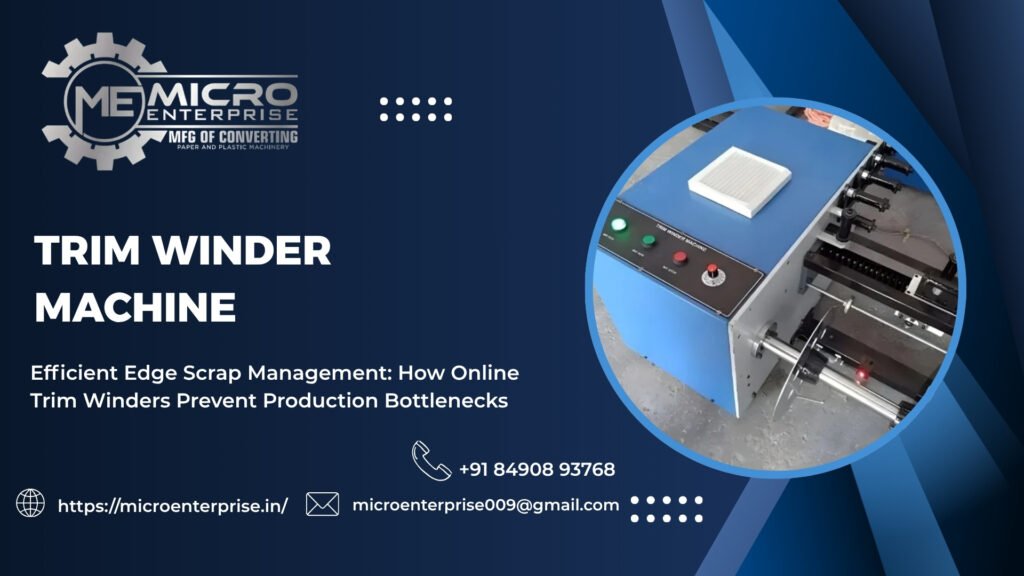
Efficient Edge Scrap Management: How Online Trim Winders Prevent Production Bottlenecks
In flexible packaging converting, paper converting, plastic film slitting, laminate manufacturing, and non-woven fabric processing, primary slitter rewinders generate continuous ribbons of edge trim scrap. To achieve straight, defect-free slit roll edges, thin border strips must be continuously trimmed off both outer edges of the moving parent web during high-speed slitting operations.
Managing continuous edge scrap without interrupting high-speed converting lines depends fundamentally on the auxiliary efficiency of an online Trim Winder Machine.
An industrial trim winder incorporates independent variable-speed drive motors, level-wind traverse guide mechanisms, tension-sensing dancer arms, pneumatic web guide chutes, and heavy-duty spool mandrels designed to collect edge scrap ribbons continuously.
Failing to manage edge trim scrap efficiently on high-speed slitting lines causes frequent edge trim wrapping around rotating shafts, static-driven web jamming, unexpected slitter stops, cluttered shop floors, and severe operator safety hazards. Understanding the core theoretical mechanics governing continuous pneumatic suction transport, traverse level-winding geometry, speed-synchronized tension control, and compact scrap spooling enables converting engineers to eliminate production bottlenecks completely. This comprehensive technical guide provides an in-depth theoretical analysis of how online trim winders ensure efficient edge scrap management.
Theoretical Kinetics of Continuous Edge Scrap Evacuation and Traverse Spooling
Online trim winders operate as synchronized auxiliary systems that pull, transport, traverse, and wind continuous edge scrap ribbons into dense, manageable spools:
+-----------------------------------------------------------------+
|                   HIGH-SPEED SLITTING KNIFE ZONE                |
| (Rotary knives trim thin border scrap ribbons off parent web)   |
+-----------------------------------------------------------------+
                                  |
                                  v
+-----------------------------------------------------------------+
|             PNEUMATIC SUCTION EVACUATION & DANCER TENSIONING    |
| (Venturi tubes pull scrap strips into tension-regulated channel)|
+-----------------------------------------------------------------+
                                  |
                                  v
+-----------------------------------------------------------------+
|             TRAVERSE LEVEL-WINDING & DENSE SPOOL BUILDING       |
| (Reciprocating traverse arms wind scrap evenly across core)    |
+-----------------------------------------------------------------+
1. Pneumatic Suction Evacuation and Dynamic Tension Matching
Theoretical Principle: As edge trim ribbons are severed at the slitting knife station, they lack structural lateral stiffness and are prone to static attraction or air resistance collapse. Pneumatic Venturi trim injectors create continuous low-pressure suction, pulling the severed scrap strips instantly into collection chutes.
Speed-Synchronized Tension Matching: The trim winder drive motor matches its rotational speed dynamically with the primary slitter’s line velocity. A light-load dancer arm senses scrap ribbon tension continuously, adjusting trim winder motor speed in real time to prevent scrap tearing or slack buildup.
2. Traverse Level-Winding Mechanics and High-Density Spooling
Theoretical Principle: Winding long, narrow scrap ribbons onto a single stationary point builds unstable, narrow disks that easily collapse and tangle. Trim winders utilize reciprocating traverse mechanisms (level-winders) that guide the incoming scrap ribbon back and forth axially across the entire length of a wide core.
Compact Scrap Consolidation: Reciprocating traverse spooling packs hundreds of meters of continuous edge trim into dense, self-supporting cylindrical spools. This compact consolidation allows long production runs to proceed without stopping the primary slitter rewinder to handle scrap.
Best Practices for Foil Converting Operations
Maintain Razor-Sharp Shear Blades: Inspect rotary shear knives frequently. Dull blades create microscopic edge cracks that cause the foil web to snap instantly under tension.
Keep Guide Paths Immaculate: Regularly clean all idlers and guide surfaces to prevent foil fragments, dust, or adhesive residue from scratching the soft metallic surface.
Ensure Pre-Cut Core Quality: Always use clean, perfectly square core tubes prepared on an automated paper core cutting machine to eliminate core wobbling and ensure smooth friction ring performance during foil winding.
Comprehensive Analysis of Online Trim Winder Integration
Integrating an online trim winder machine into material converting workflows delivers distinct operational and environmental benefits:
Elimination of High-Speed Machine Bottlenecks: Collecting edge scrap continuously online prevents trim entanglement around slitting knives, eliminating unscheduled machine stoppages and maximizing total converting line efficiency.
Enhanced Workplace Safety and Cleanliness: Winding scrap into neat spools keeps loose plastic film and paper ribbons off plant floors, reducing tripping hazards and keeping converting environments clean and organized.
Controlled Electrostatic Charge Dissipation: Passing charged synthetic film trims across grounded metallic guide rollers and active ionizing nozzles prevents static cling from clogging trim extraction ducts.
Facilitation of Material Recycling and Circularity: Winding clean, single-polymer edge trims into tight spools simplifies material handling for recycling shredders and granulators, supporting sustainable manufacturing initiatives.
System Integration Across Converting Machinery Infrastructure
Trim winder machinery operates in direct support of a complete portfolio of industrial material converting equipment:
Dedicated Edge Scrap Management: Continuous online trim collection, traverse level-winding, and scrap consolidation are performed on a Trim Winder Machine.
General Substrate Converting: Universal high-speed slitting and tension control across flexible substrates are handled on a Slitting Rewinding Machine.
Paper Reel Converting: Precision paper reel slitting and roll density control are handled on a heavy-duty Paper Slitting Rewinding Machine.
Metallic Foil Processing: Precision thin aluminum foil slitting with anti-static control is executed on a specialized Foil Rewinding Machine.
Flexible Film Converting: Tension-sensitive BOPP and PET film slitting without stretching is managed on a BOPP Film Slitting Rewinding Machine.
Heavy Woven Fabric Slitting: Industrial synthetic fabric edge trimming is achieved on a robust HDPE Fabric Slitting Rewinding Machine.
Quality Inspection & Defect Mapping: High-speed optical defect detection and web surface quality mapping are integrated into an Inspection Rewinding Machine.
Economical Single Shaft Winding: Simple, compact narrow web winding on a single mandrel is performed on a Single Shaft Slitting Rewinding Machine.
Surface Drive Roll Formation: Large-diameter roll formation driven by uniform contact nip pressure is achieved using a Surface Slitting Rewinding Machine.
Multi-Motor Heavy Roll Systems: Large jumbo roll management with independent drive motors is handled on a 3 Drive Drum Type Slitting Rewinding Machine.
Cantilever Ergonomic Handling: Rapid core loading and cantilever arm swing-out operations are enabled by a Cantilever Slitting Rewinding Machine.
Roll Salvaging & Defect Repair: Damaged, telescoped, or off-spec finished rolls are re-spooled and corrected using a Doctoring Rewinding Machine.
Theoretical Best Practices for Trim Winder Operation
To ensure continuous edge scrap evacuation, prevent trim breakage, and maintain high converting speeds, engineers follow three core theoretical guidelines:
Synchronize Trim Winder Inverter Drives with Main Slitter Speed: Connect trim winder motor drives to the main slitter speed reference signal to ensure instant, synchronized acceleration and deceleration without breaking delicate trim strips.
Adjust Traverse Pitch Angles Based on Trim Width: Calibrate the axial speed of the traverse level-wind arm relative to spool rotation speed to ensure tight, uniform lay-down without overlap bulging.
Install Antistatic Ionization Bars in Trim Ducting: Mount active ionizing bars inside trim collection funnels to neutralize triboelectric charges before film trims enter the traverse spooling zone.
Conclusion
Understanding the theoretical mechanics of pneumatic suction transport, traverse level-winding geometry, speed-synchronized tension control, and static charge dissipation is essential for managing edge scrap effectively with online trim winders. By deploying automated trim winders, synchronizing spooling speeds with main slitting lines, utilizing traverse mechanisms, and maintaining clean scrap handling pathways, converting facilities eliminate production bottlenecks, maintain clean shop floors, and maximize high-speed operational productivity.
Looking for High-Efficiency Edge Trim Management and Converting Machinery? Explore our complete range of specialized Trim Winder Machine setups, high-speed Slitting Rewinding Machine units, heavy-duty Paper Slitting Rewinding Machine setups, specialized Foil Rewinding Machine setups, sensitive BOPP Film Slitting Rewinding Machine lines, industrial HDPE Fabric Slitting Rewinding Machine systems, advanced Inspection Rewinding Machine setups, compact Single Shaft Slitting Rewinding Machine models, heavy Surface Slitting Rewinding Machine lines, multi-motor 3 Drive Drum Type Slitting Rewinding Machine systems, ergonomic Cantilever Slitting Rewinding Machine units, and corrective Doctoring Rewinding Machine stations at Micro Enterprise. Contact our expert engineering team today.
 Users Today : 5
 Users This Month : 290
 Total Users : 3413