
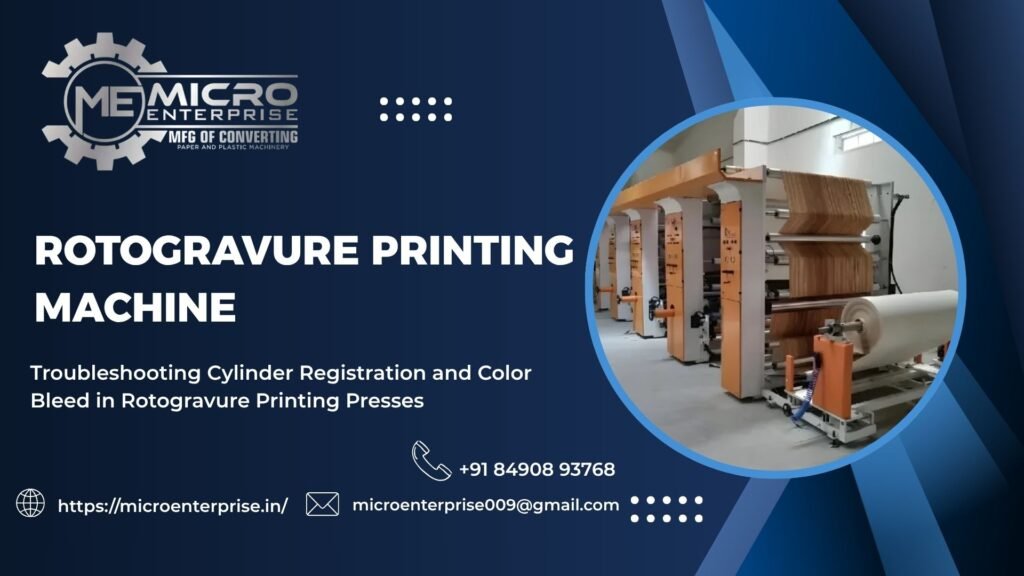
Troubleshooting Cylinder Registration and Color Bleed in Rotogravure Printing Presses
In multi-color flexible packaging printing, food pouch converting, high-barrier film decoration, and decorative paper laminates, rotogravure printing technology remains the industry standard for long-run, high-definition graphical output. Rotogravure presses utilize direct image transfer from cell-engraved copper-plated cylinders onto fast-moving continuous substrates, offering unmatched color consistency and durability.
Achieving sharp dot reproduction and crisp multi-color registration depends fundamentally on the structural precision of an advanced Rotogravure Printing Machine.
An industrial rotogravure press incorporates heavy-duty unwinds, motorized cylinder chucking units, precision doctor blade assemblies, impression rollers, drying hoods, electronic web compensators, and automated registration control systems designed to maintain color fidelity across multiple printing stations.
Operating high-speed rotogravure presses without maintaining precise mechanical cylinder alignment and ink fluid properties causes severe color bleed, ghosting, print misregistration, streaking, dot gain distortion, and high substrate scrap rates. Understanding the core theoretical mechanics governing cell-to-substrate ink transfer, doctor blade wipe efficiency, dynamic web tension stabilization, and ink solvent evaporation kinetics enables printing engineers to troubleshoot print defects. This comprehensive technical guide provides an in-depth theoretical analysis of troubleshooting cylinder registration and color bleed in rotogravure printing presses.
Theoretical Dynamics of Gravure Ink Transfer and Registration Mechanics
Rotogravure printing relies on mechanical cell filling, precise doctor blade doctoring, and exact spatial alignment across sequential color stations:
+-----------------------------------------------------------------+
|                   ENGRAVED CYLINDER INK PICKUP                  |
| (Engraved microscopic cells submerge in liquid ink pan)          |
+-----------------------------------------------------------------+
                                  |
                                  v
+-----------------------------------------------------------------+
|               PRECISION DOCTOR BLADE WIPING ACTION              |
| (Blade wipes un-engraved cylinder surface completely clean)     |
+-----------------------------------------------------------------+
                                  |
                                  v
+-----------------------------------------------------------------+
|             HIGH-PRESSURE IMPRESSION TRANSFER & DRYING          |
| (Rubber nip roller transfers ink to web; dryer flashes solvent)|
+-----------------------------------------------------------------+
1. Cell Fluid Dynamics and Doctor Blade Wipe Mechanics
Theoretical Principle: Rotogravure cylinders feature millions of microscopic engraved cells that carry fluid ink. As the cylinder rotates through an ink pan, cells fill with ink. A trailing doctor blade wiped against the spinning cylinder surface strips away excess ink from non-image areas, leaving ink only inside the cells.
Color Bleed and Trailing Flaws: If the doctor blade angle, contact pressure, or edge profile is defective, excess ink escapes past the wipe zone. This residual surface film transfers onto the substrate, creating unwanted color bleed, haze, and feathering around graphic borders.
2. Multi-Station Web Registration Kinetics
Theoretical Principle: Multi-color printing requires placing consecutive ink layers (Cyan, Magenta, Yellow, Key, and spot colors) on top of each other with sub-millimeter precision. As the flexible substrate travels between print units, thermal drying hoods heat the web, causing micro-expansion or contraction.
Misregistration Correction: Electronic registration control systems monitor printed mark registration dots using optical eye sensors. These sensors detect spatial shifts instantly, signaling motorized compensator rollers or direct servo-drive cylinders to adjust phase timing and restore exact color registration.
Comprehensive Analysis of Print Defect Root Causes
Isolating and resolving cylinder registration drift and color bleed in rotogravure presses requires evaluating interconnected mechanical and fluid parameters:
Ink Viscosity and Solvent Evaporation Rate Discrepancies: Extremely low ink viscosity leads to capillary bleeding and feathering across substrate fibers, while excessively high viscosity prevents full cell emptying, causing mottling and faint coverage.
Impression Roller Pressure and Shore Hardness Variations: Non-uniform pneumatic pressure across the rubber impression roller alters the transfer contact nip width, squeezing wet ink laterally and causing graphic edge distortion.
Thermal Web Expansion and Dryer Temperature Control: Overheating drying hoods between print stations stretches heat-sensitive plastic films, altering path lengths between cylinders and causing permanent longitudinal misregistration.
Cylinder Eccentricity and Bearing Wear: Slight mechanical run-out or worn journal bearings on gravure cylinders induce cyclical vibration, generating periodic registration chatter marks and color haloing.
System Integration Across Printing Machinery Infrastructure
Rotogravure printing machinery functions as a core graphic application asset within comprehensive material converting plants:
Direct Cylinder Printing Technology: High-speed multi-color printing and precise registration control are executed on a heavy-duty Rotogravure Printing Machine.
Rapid Cylinder Changeover Systems: Fast ergonomic cylinder loading using pneumatic chucking setups is enabled by a Shaftless Printing Machine.
Paper Substrate Converting: Specialized paper drying tunnel management and low-stretch web tension control are handled on a Paper Rotogravure Printing Machine.
Decorative Foil Stamping: High-precision hot and cold metallic foil transfer onto packaging webs is performed on a Foil Printing Machine.
Anilox Flexographic Printing: Precise fluid metering using structured ceramic anilox rolls is managed on a Flexo Printing Machine.
Theoretical Best Practices for Gravure Press Optimization
To eliminate color bleed, maintain tight cylinder registration, and deliver high-definition print quality, printing engineers follow three core theoretical guidelines:
Maintain Precise Ink Viscosity and Solvent Balance: Implement automated viscometers to monitor and adjust solvent dosing continuously, keeping ink viscosity within strict operational ranges.
Optimize Doctor Blade Angle and Oscillation: Set doctor blade contact angles correctly against the cylinder curvature and maintain smooth lateral blade oscillation to prevent localized cylinder wear and streaking.
Calibrate Closed-Loop Register Sensors: Clean optical register sensors regularly and calibrate electronic compensator response loops to correct micro-web displacement before visible misregistration occurs.
Conclusion
Understanding the theoretical mechanics of gravure cell fluid release, doctor blade wipe efficiency, thermal web expansion, and closed-loop optical registration control is essential for troubleshooting color bleed and cylinder misregistration. By maintaining precise ink viscosity, optimizing impression roller nip pressure, controlling dryer temperature profiles, and utilizing active registration compensators, packaging printers produce sharp graphic outputs and maximize press productivity.
Looking for High-Precision Printing and Converting Machinery? Explore our complete range of advanced Rotogravure Printing Machine units, ergonomic Shaftless Printing Machine models, high-speed Paper Rotogravure Printing Machine systems, precision Foil Printing Machine setups, and versatile Flexo Printing Machine setups at Micro Enterprise. Contact our expert engineering team today.
 Users Today : 5
 Users This Month : 290
 Total Users : 3413