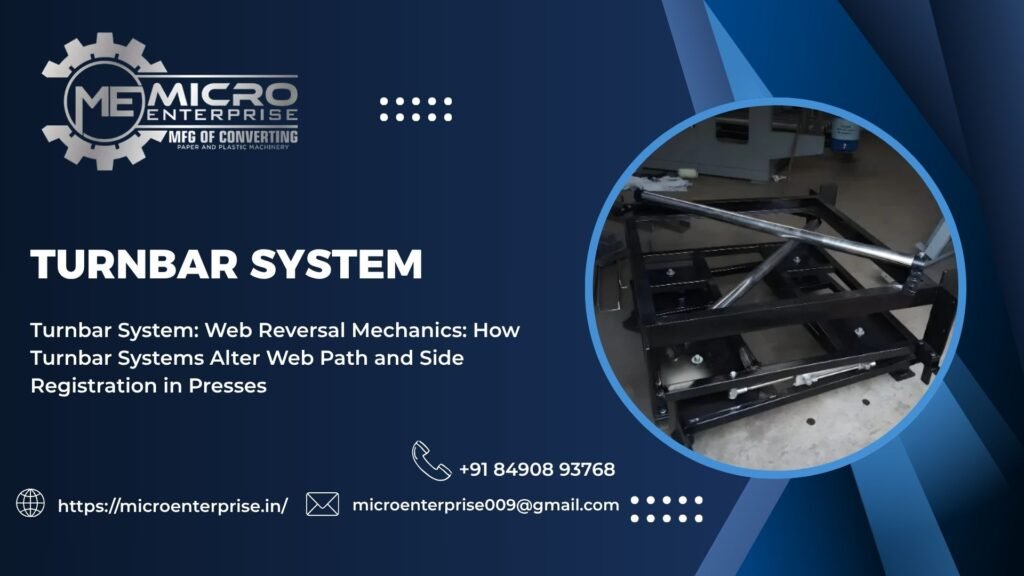
Web Reversal Mechanics: How Turnbar Systems Alter Web Path and Side Registration in Presses
In multi-color web printing, inline flexographic label production, commercial offset printing, and multi-ply packaging film converting, printing on both sides of a continuous moving substrate (duplex printing) is a common operational requirement. Passing a continuous web through sequential inline printing stations typically decorates only the top surface of the material.
Achieving back-side printing, reversing web orientation, or shifting lateral web alignment without adding separate print lines depends fundamentally on the mechanical precision of an advanced Turnbar System.
An industrial turnbar system incorporates precision-ground hollow turning bars mounted at exact 45-degree angles, air-cushion perforation arrays, motorized lateral positioning slides, web guiding sensor arrays, and low-friction idle rollers designed for inline web redirection.
Attempting to flip moving webs using improper mechanical guide arrangements or un-aerated stationary bars leads to severe web boundary friction, surface scratching, print smearing, high web tension spikes, lateral registration drift, and catastrophic web tears. Understanding the core theoretical mechanics governing 45-degree angle bar geometry, aerated boundary-layer air flotation, lateral web shifting kinetics, and side-registration compensation enables converting engineers to optimize web path alterations. This comprehensive technical guide provides an in-depth theoretical analysis of how turnbar systems alter web paths and side registration in presses.
Theoretical Kinetics of Web Reversal and Air-Cushion Flotation
Turnbar systems utilize stationary, air-assisted turning bars set at specific angular offsets to alter web direction and invert web surfaces smoothly:
+-----------------------------------------------------------------+
|                   INLINE WEB TRAVEL (TOP-SIDE PRINTED)          |
| (Continuous web enters turnbar module from primary print unit)  |
+-----------------------------------------------------------------+
                                  |
                                  v
+-----------------------------------------------------------------+
|             45-DEGREE ANGLED BAR & AIR CUSHION FLOTATION        |
| (Web wraps 180° around aerated bar; web flips back-side up)     |
+-----------------------------------------------------------------+
                                  |
                                  v
+-----------------------------------------------------------------+
|             LATERAL SIDE REGISTRATION & DOWNSTREAM INFEED       |
| (Motorized axial adjustment shifts web laterally into next unit)|
+-----------------------------------------------------------------+
1. 45-Degree Angle Bar Geometry and 180-Degree Web Inversion
Theoretical Principle: Placing a cylindrical bar at a precise 45-degree angle relative to incoming web travel causes a 180-degree wrap around the bar surface. This geometric redirection turns the moving web by 90 degrees laterally while simultaneously flipping the top surface of the web to face downward.
Duplex Printing Configuration: Utilizing a dual-turnbar arrangement allows the web to be turned 90 degrees on the first bar and another 90 degrees on the second bar. This restores parallel longitudinal web travel while leaving the bottom (unprinted) side facing upward for reverse-side printing.
2. Micro-Perforated Air Cushion Flotation and Surface Protection
Theoretical Principle: Wrapping a wet or sensitive printed web over a stationary steel bar generates high sliding friction and contact shear. Internal pneumatic pressure forces compressed air through micro-perforations across the turnbar outer wall.
Friction-Free Aerodynamic Levitation: This escaping air forms a continuous micro-thin air cushion between the metallic bar and the moving substrate. The web floats on this boundary air layer, eliminating surface friction, preventing ink smudging on pre-printed surfaces, and suppressing web tension spikes.
Comprehensive Analysis of Side Registration and Web Path Mechanics
Optimizing turnbar systems for high-speed printing presses requires balancing geometric alignment with active lateral web controls:
Motorized Axial Side-Registration Compensation: Mounting turnbar assemblies on precision motorized linear slides allows operators to adjust the axial position of the turning bar, shifting the lateral entry point of the web to align perfectly with downstream printing plates.
Controlled Web Tension Boundary Isolation: Maintaining steady web tension ahead of and following the turnbar prevents web fluttering over the air cushion, preserving stable lateral tracking across turning angles.
Air Cushion Pressure Regulation: Adjusting internal turnbar air pressure based on substrate breathability and web weight ensures optimal flotation height without causing web ballooning or edge curling.
Integrated Web Guide Sensor Synchronization: Pairing turnbar modules with downstream edge or center-line optical sensors provides real-time feedback to motorized turnbar positioners, eliminating lateral registration drift during long production runs.
System Integration Across Machinery & Converting Infrastructure
A specialized turnbar system operates as a core web routing module alongside a complete suite of industrial converting and web-handling machinery:
Web Path Reversal & Angle Turning: Changing web directions and reversing printing sides precisely are managed on an advanced Turnbar System.
Pneumatic Edge Scrap Evacuation: Continuous suction transport and trim evacuation on extrusion and slitting lines are handled by a Trimming Blower System.
Automated Pallet Wrapping: High-efficiency stretch wrapping and load containment are executed using a Stretch Wrapping Machine.
Hydraulic System Power: Fluid pressure generation and hydraulic actuator drives are powered by a heavy-duty Power Pack.
Core Gripping & Mandrel Expansion: Slip-free core locking and roll support during winding are provided by Air Shafts.
Hardened Surface Rollers: Maximum wear and corrosion resistance across web path rollers are provided by a Steel Roller (Hard Chrome Plated).
Elastomeric Nip Rollers: Controlled pressure nip application and surface friction drive are handled using Rubber Rollers.
High-Speed Printing Mandrels: Vibration-free, dynamically balanced cylinder holding is achieved using precision Cylinder Shafts.
Mechanical Power Transmission: Synchronized drive torque distribution across machinery sections is delivered via Line Shafts.
Low-Inertia Web Support: Fast rotational response and smooth film guiding without drag are ensured by Aluminium Guide Rollers.
Material Handling Conveying: Efficient product and package transport lines are supported by heavy-duty Conveyor Rollers.
Core Slicing Equipment: Burr-free precision cutting of paper and cardboard cores is performed on an automated Paper Core Cutting Machine.
Theoretical Best Practices for Turnbar System Operation
To ensure precise back-side printing registration, eliminate surface ink transfer, and maintain high press speeds, printing engineers follow three core theoretical guidelines:
Verify Exact 45-Degree Angular Calibration: Ensure turnbar mounting frames maintain precise 45-degree angular alignments; minor angular errors cause cumulative web tracking drift and lateral web creasing.
Balance Flotation Air Supply Across Web Width: Regulate internal pneumatic pressure to maintain an even air film thickness under both web edges, preventing air leakage from causing uneven web tilt.
Synchronize Turnbar Positioners with Main Register Controls: Connect motorized turnbar axial drives directly to press auto-registration control loops for automated side-register correction during speed changes.
Conclusion
Understanding the theoretical mechanics of 45-degree angle bar geometry, micro-perforated air-cushion levitation, lateral side-registration shifting, and tension boundary control is essential for altering web paths effectively using turnbar systems. By implementing aerated turning bars, utilizing motorized axial positioners, maintaining precise web tension, and integrating downstream edge guiding sensors, printing facilities achieve flawless duplex printing registration, prevent surface marking, and maximize press versatility.
Looking for Advanced Web Handling and Machinery Components? Explore our complete range of specialized machinery solutions including precise Turnbar System setups, pneumatic Trimming Blower System units, automated Stretch Wrapping Machine models, heavy-duty Power Pack units, expanding Air Shafts, durable Steel Roller (Hard Chrome Plated) units, resilient Rubber Rollers, high-precision Cylinder Shafts, synchronized Line Shafts, low-inertia Aluminium Guide Rollers, heavy-duty Conveyor Rollers, and precise Paper Core Cutting Machine units at Micro Enterprise. Contact our expert engineering team today.
 Users Today : 5
 Users This Month : 290
 Total Users : 3413