Anilox Roll Selection Guide: Matching Cell Volume to Ink Transfer Requirements in Flexography
In modern flexible packaging printing, corrugated box converting, pressure-sensitive label production, and eco-friendly paper bag manufacturing, flexographic printing offers unmatched operational speed and substrate versatility. Flexography relies on elastomeric or photopolymer relief plates to transfer fluid inks onto continuous packaging webs across high-speed printing presses.
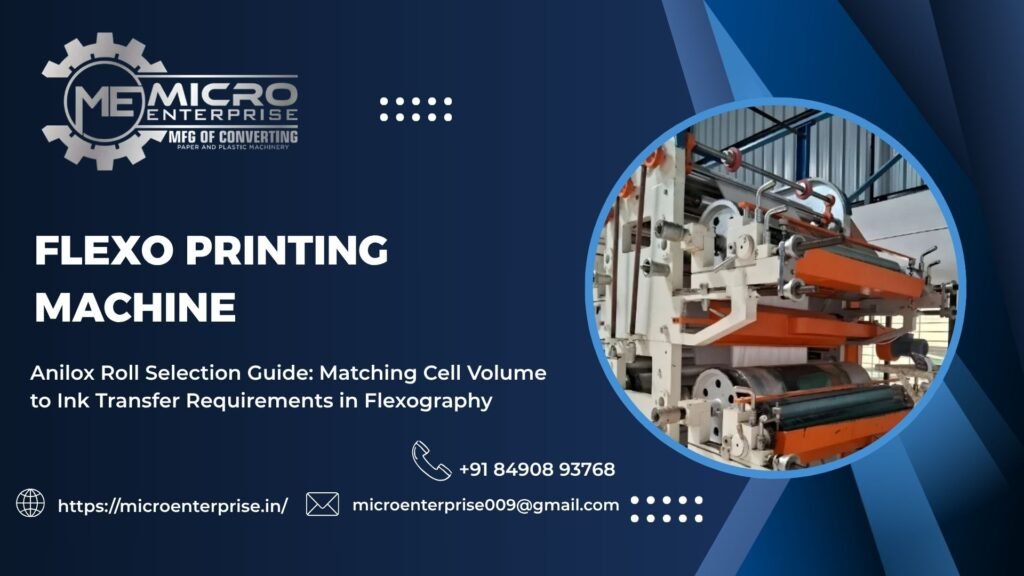
Achieving exact ink film thickness, vibrant color density, and crisp halftone detail depends fundamentally on the engineering accuracy of a high-performance Flexo Printing Machine.
An industrial flexo printing press incorporates central impression or stack-type drive frames, laser-engraved ceramic anilox rolls, enclosed doctor blade ink chambers, photopolymer plate cylinders, high-velocity drying hoods, and automated web guiding systems designed for fluid ink management.
Operating flexographic presses without matching anilox cell volumes and screen counts to graphic artwork requirements leads to severe ink flooding, dot gain, muddy halftone reproduction, low color density, pinholing, and high substrate material waste. Understanding the core theoretical mechanics governing laser cell volume capacity, surface tension release properties, chambered doctor blade wipe efficiency, and fluid transfer ratios enables printing engineers to optimize press performance. This comprehensive technical guide provides an in-depth theoretical analysis of selecting anilox rolls based on matching cell volume to ink transfer requirements in flexography.
Theoretical Dynamics of Anilox Roll Fluid Metering and Ink Transfer
The ceramic anilox roll serves as the volumetric measuring heart of the flexographic printing process, metering precise microscopic fluid ink layers onto printing plates:
+-----------------------------------------------------------------+
|                   ENCLOSED CHAMBER INK FEED SYSTEM              |
| (Fluid ink fills laser-engraved microscopic ceramic cells)      |
+-----------------------------------------------------------------+
                                  |
                                  v
+-----------------------------------------------------------------+
|             CHAMBERED DOCTOR BLADE WIPING DYNAMICS              |
| (Reverse-angle blade wipes excess surface ink from ceramic roll)|
+-----------------------------------------------------------------+
                                  |
                                  v
+-----------------------------------------------------------------+
|             PHOTOPOLYMER PLATE TRANSFER & SUBSTRATE PRINT       |
| (Surface tension forces draw controlled ink film onto plate dots)|
+-----------------------------------------------------------------+
1. Laser-Engraved Cell Geometry and Volumetric Fluid Capacity
-
Theoretical Principle: Ceramic anilox rolls feature millions of laser-engraved microscopic cells (hexagonal 60-degree, 45-degree, or elongated channel geometries). Cell volume represents the theoretical carrying capacity of wet ink held within these microscopic cavities.
-
Cell Volume vs. Ink Film Thickness: High cell volumes carry greater wet ink quantities required for heavy solid coverage and opaque white backgrounds. Conversely, low cell volumes carry micro-thin fluid layers necessary for fine-line typography and high-screen halftone process printing without dot bridging.
2. Surface Energy and Hydrodynamic Ink Transfer Mechanics
-
Theoretical Principle: Transferring ink from anilox cells to photopolymer plate dot surfaces relies on differential surface energy and split-film fluid dynamics. As the rotating anilox roll meets the flexo plate under light contact nip pressure, capillary forces draw a portion of the ink out of the cells.
-
Dot Gain and Hydrodynamic Overflooding: If the anilox cell carrying volume exceeds the holding capacity of the photopolymer plate highlight dots, excess ink squeezes outward under nip pressure. This causes physical dot gain, haloing around fine text, and dirty halftone printing.
Comprehensive Analysis of Anilox Selection Criteria
Selecting the ideal ceramic anilox roll configuration for specific flexographic printing applications requires evaluating interconnected mechanical and chemical parameters:
-
Screen Count (LPI/LPCM) to Plate Screen Ratio Matching: Selecting an anilox screen count four to six times higher than the photopolymer plate screen frequency ensures that tiny highlight plate dots sit supported on cell walls without dipping into cell cavities.
-
Enclosed Doctor Blade Chamber Wiping Efficiency: Maintaining uniform reverse-angle doctor blade wiping pressure strips non-image ceramic surface areas completely clean, ensuring that only the measured ink volume inside cells transfers to the plate.
-
Substrate Surface Absorbency and Dyne Energy: Porous paper substrates absorb ink rapidly and require higher anilox cell volumes, whereas non-porous films require low-volume, high-screen anilox rolls to maintain sharp ink dot integrity.
-
Ink Viscosity and Rheological Properties: Water-based, solvent-based, and UV-curable flexo inks exhibit distinct surface tension and viscosity characteristics that govern how efficiently ink releases from ceramic cell walls.
System Integration Across Printing Machinery Infrastructure
Flexographic printing presses operate alongside a complete portfolio of high-efficiency graphic converting equipment:
-
Precision Flexographic Fluid Metering: High-speed fluid ink metering, anilox roll integration, and flexible printing execution are managed on a Flexo Printing Machine.
-
Direct Cylinder Gravure Printing: High-definition multi-color gravure printing and inline drying management are performed on a Rotogravure Printing Machine.
-
Rapid Shaftless Cylinder Changing: Fast ergonomic printing cylinder loading using pneumatic chucking setups is enabled by a Shaftless Printing Machine.
-
Paper Substrate Graphic Converting: Specialized paper drying tunnel management and low-stretch web tension control are handled on a Paper Rotogravure Printing Machine (i.e. Paper Rotogravure Printing Machine).
-
Decorative Metallic Foil Stamping: High-precision hot and cold metallic foil application onto flexible packaging webs is performed on a Foil Printing Machine.
Theoretical Best Practices for Flexo Press Anilox Optimization
To eliminate dot gain, achieve exact color density, and maximize flexographic press productivity, printing engineers follow three core theoretical guidelines:
-
Implement Ultrasonic Anilox Roll Cleaning Routines: Clean ceramic anilox rolls periodically using ultrasonic or microscopic media-blasting systems to remove dried ink deposits that reduce effective cell volume capacity over time.
-
Match Cell Geometry to Ink Type: Utilize 60-degree hexagonal or open-channel cell geometries for high-viscosity inks to facilitate full cell evacuation and smooth laydown.
-
Calibrate Impression Nip Pressure Settings: Maintain kiss-impression contact pressure between the anilox roll and printing plate to prevent premature plate wear and excessive fluid squeeze-out.
Conclusion
Understanding the theoretical mechanics of laser cell engraving, surface energy ink release, chambered doctor blade wiping efficiency, and screen count ratios is essential for optimizing anilox roll selection in flexography. By matching cell volumes to specific graphic requirements, maintaining clean anilox surfaces, regulating doctor blade wiping, and controlling impression nip pressure, flexographic converters achieve vibrant, sharp graphic reproductions and maximize press efficiency.
Looking for High-Precision Flexo Printing and Converting Machinery? Explore our complete range of versatile Flexo Printing Machine models, high-definition Rotogravure Printing Machine units, ergonomic Shaftless Printing Machine setups, high-speed Paper Rotogravure Printing Machine systems, and precision Foil Printing Machine setups at Micro Enterprise. Contact our expert engineering team today.
 Users Today : 5
 Users This Month : 290
 Total Users : 3413