
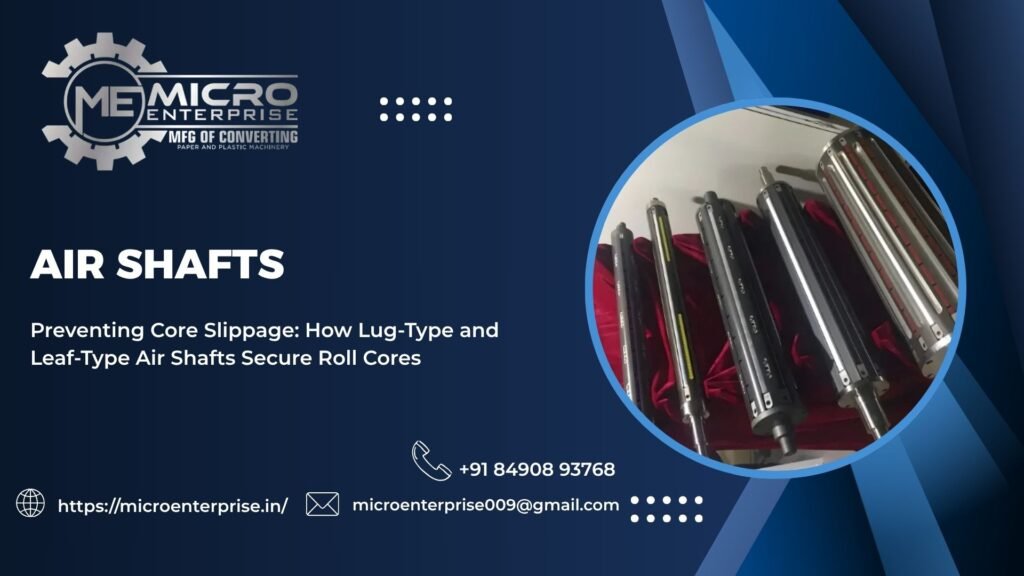
Preventing Core Slippage: How Lug-Type and Leaf-Type Air Shafts Secure Roll Cores
In high-speed paper slitting, film laminating, foil converting, textile processing, and printing press unwind/rewind operations, securing hollow roll cores onto rotating mandrels is a critical mechanical requirement. As parent reels unwind or slit coils build up weight, high torque must transfer smoothly between drive shafts and cardboard, plastic, or metallic roll cores without slippage or radial movement.
Ensuring zero roll core deformation and slip-free rotational power transmission depends fundamentally on the engineering precision of high-rigidity Air Shafts.
An industrial pneumatic air shaft incorporates a hollow steel or aluminum body, internal rubber air bladders, fast-charging pneumatic valves, continuous return springs, and radially expanding gripping elements (lugs, leaves, or continuous strips) designed for rapid core loading and clamping.
Operating winding mandrels with worn mechanical chucks or improper expanding shafts leads to severe core slippage, core wall crushing, uneven web tension, telescoping roll profiles, rotational vibration, and high material scrap rates. Understanding the core theoretical mechanics governing pneumatic bladder inflation pressure, radial force distribution, surface contact friction kinetics, and structural mandrel deflection enables converting engineers to select optimal expanding shaft configurations. This comprehensive technical guide provides an in-depth theoretical analysis of how lug-type and leaf-type air shafts secure roll cores to prevent slippage.
Theoretical Dynamics of Pneumatic Expansion and Radial Core Gripping
Air shafts utilize compressed air pressure to drive internal expanding elements radially outward against the inner walls of paper or plastic cores:
+-----------------------------------------------------------------+
|                   PNEUMATIC CHARGING INTAKE VALVE               |
| (Compressed air enters valve, inflating internal rubber bladder)|
+-----------------------------------------------------------------+
                                  |
                                  v
+-----------------------------------------------------------------+
|             RADIAL ELEMENT EXPANSION & CORE ENGAGEMENT          |
| (Bladder pushes steel lugs or aluminum leaves radially outward)|
+-----------------------------------------------------------------+
                                  |
                                  v
+-----------------------------------------------------------------+
|             HIGH-TORQUE FRICTION LOCK & CONCENTRIC WINDING      |
| (Radial force locks core wall, transmitting slip-free drive)    |
+-----------------------------------------------------------------+
1. Pneumatic Bladder Expansion and Radial Force Generation
Theoretical Principle: Applying compressed air through a quick-charge valve inflates an internal elastomeric bladder housed within the central steel body cavity. As air pressure builds, the bladder expands radially against internal push rods.
Frictional Core Locking Mechanics: The expanding bladder forces external steel lugs or continuous aluminum leaves outward through body slots. These elements press firmly against the inside bore of the roll core, converting fluid air pressure into high mechanical clamping force that prevents core rotation relative to the shaft.
2. Structural Dynamics: Lug-Type vs. Leaf-Type Mechanics
Theoretical Principle: Selecting between lug-type and leaf-type configurations depends on the material composition, wall thickness, and torque requirements of the roll cores:
Lug-Type Air Shafts: Feature individual hardened steel or rubber gripping keys positioned at intervals along the shaft. Lugs penetrate slightly into heavy-gauge cardboard core inner walls, delivering high localized gripping torque for high-tension multi-slit rewinding.
Leaf-Type Air Shafts: Feature continuous, full-length aluminum or steel expandable leaves that provide 360-degree circumferential contact. The continuous leaf distribution spreads gripping pressure uniformly, preventing thin-walled cardboard or delicate plastic cores from deforming out-of-round.
Comprehensive Analysis of Core Locking Quality Parameters
Optimizing expandable air shaft performance across high-speed converting machinery requires evaluating interconnected mechanical design factors:
Pneumatic Pressure Inflation Calibration: Maintaining stable pneumatic charge pressure ensures constant radial expansion force throughout long unwinding or rewinding cycles.
Concentric Alignment and Dynamic Balance Retention: Precision-machined expanding elements center the core precisely around the shaft rotational axis, suppressing high-speed rotational run-out and vibration.
Internal Return Spring Retraction Dynamics: Robust internal mechanical return springs retract gripping lugs or leaves completely flush into the shaft body upon air release, allowing effortless core loading and unloading.
Substrate Torque Demand and Core Wall Strength: Matching shaft gripping geometry (lugs for heavy torque, leaves for thin cores) prevents core wall crushing while providing necessary rotational resistance against web tension forces.
System Integration Across Machinery & Converting Infrastructure
High-performance expanding air shafts serve as fundamental web handling mandrels across a complete range of industrial converting and processing equipment:
Core Gripping & Mandrel Expansion: Slip-free core locking and roll support during winding are provided by high-rigidity Air Shafts.
Pneumatic Edge Scrap Removal: Continuous suction transport and trim evacuation on converting lines are handled by a Trimming Blower System.
Web Path Reversal & Angle Turning: Changing web directions and reversing printing sides precisely are managed on a Turnbar System.
Automated Pallet Wrapping: High-efficiency stretch wrapping and load containment are executed using a Stretch Wrapping Machine.
Hydraulic System Power: Fluid pressure generation and hydraulic actuator drives are powered by a heavy-duty Power Pack.
Hardened Surface Rollers: Maximum wear and corrosion resistance across web path rollers are provided by a Steel Roller (Hard Chrome Plated).
Elastomeric Nip Rollers: Controlled pressure nip application and surface friction drive are handled using Rubber Rollers.
High-Speed Printing Mandrels: Vibration-free, dynamically balanced cylinder holding is achieved using precision Cylinder Shafts.
Mechanical Power Transmission: Synchronized drive torque distribution across machinery sections is delivered via Line Shafts.
Low-Inertia Web Support: Fast rotational response and smooth film guiding without drag are ensured by Aluminium Guide Rollers.
Material Handling Conveying: Efficient product and package transport lines are supported by heavy-duty Conveyor Rollers.
Core Slicing Equipment: Burr-free precision cutting of paper and cardboard cores is performed on an automated Paper Core Cutting Machine.
Theoretical Best Practices for Air Shaft Optimization
To eliminate core slippage, prevent core damage, and extend air shaft service life, converting engineers follow three core theoretical guidelines:
Verify Air Valve Seals and Bladder Integrity: Test internal bladders and pneumatic intake valves periodically for micro-leaks to prevent gradual pressure loss during long production runs.
Match Air Shaft Design to Core Material Composition: Deploy lug-type shafts for heavy multi-slit paper rolls and leaf-type shafts for delicate film cores or thin cardboard tubes.
Inspect Expansion Elements for Wear and Friction Drag: Keep external lug and leaf slots clean of dust, adhesive residue, and paper fibers to ensure smooth radial movement during inflation and deflation.
Conclusion
Understanding the theoretical mechanics of pneumatic bladder inflation, radial force transmission, lug-type torque concentration, and leaf-type continuous circumferential contact is essential for securing roll cores and preventing slippage. By selecting appropriate expanding element geometries, maintaining steady inflation pressures, ensuring complete retraction spring operation, and matching shafts to core wall strengths, converting facilities achieve slip-free web transport, preserve core integrity, and maximize machinery productivity.
Looking for Industrial Machinery and Web Handling Components? Explore our complete range of specialized equipment including expanding Air Shafts, pneumatic Trimming Blower System units, precise Turnbar System setups, automated Stretch Wrapping Machine models, heavy-duty Power Pack units, durable Steel Roller (Hard Chrome Plated) units, resilient Rubber Rollers, high-precision Cylinder Shafts, synchronized Line Shafts, low-inertia Aluminium Guide Rollers, heavy-duty Conveyor Rollers, and precise Paper Core Cutting Machine units at Micro Enterprise. Contact our expert engineering team today.
 Users Today : 5
 Users This Month : 290
 Total Users : 3413