
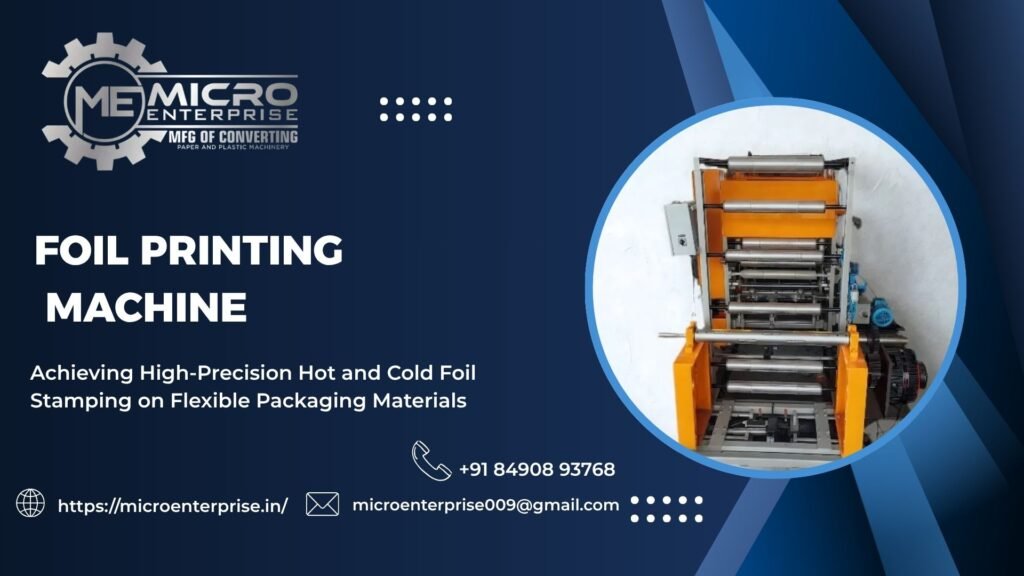
Achieving High-Precision Hot and Cold Foil Stamping on Flexible Packaging Materials
In luxury flexible packaging, premium cosmetic pouch manufacturing, pharmaceutical anti-counterfeiting packaging, and high-end label embellishment, metallic foil decoration is a primary aesthetic differentiator. Metallic foil stamping adds reflective brilliance, tactile luxury, and security branding to flexible packaging materials through precise thermal or adhesive metal layer transfer.
Achieving sharp-edged metallic foil transfers and flawless registration on heat-sensitive flexible substrates depends fundamentally on the engineering precision of an advanced Foil Printing Machine.
An industrial foil printing machine incorporates precision heating dies, UV adhesive application units, chilled impression nip rollers, web registration compensators, active static eliminators, and differential foil rewind spindles designed to handle ultra-thin metallic foil carriers.
Operating foil stamping presses without managing thermal transfer windows and adhesive curing kinetics leads to foil flaking, pinholing, incomplete metallic coverage, edge feathering, substrate heat distortion, and excessive foil carrier film waste. Understanding the core theoretical mechanics governing thermal adhesive layer melt points, cationic UV radiation polymerization, carrier film stripping shear forces, and web registration stability enables converting engineers to optimize foil stamping operations. This comprehensive technical guide provides an in-depth theoretical analysis of achieving high-precision hot and cold foil stamping on flexible packaging materials.
Theoretical Dynamics of Hot and Cold Foil Transfer Mechanics
Foil stamping transfers microscopic metallic aluminum layers from polyester carrier films onto packaging webs via thermal activation or adhesive bonding:
+-----------------------------------------------------------------+
|                   METALLIC FOIL CARRIER & SUBSTRATE INFEED       |
| (Foil carrier film aligns parallel with flexible packaging web)|
+-----------------------------------------------------------------+
                                  |
                                  v
+-----------------------------------------------------------------+
|             THERMAL DIE PRESSING OR UV ADHESIVE NIP BONDING     |
| (Heat melts release layer OR UV adhesive bonds foil to web)     |
+-----------------------------------------------------------------+
                                  |
                                  v
+-----------------------------------------------------------------+
|             PRECISION CARRIER STRIPPING & METALLIC SHIELD       |
| (Carrier film peels away cleanly, leaving crisp metallic print) |
+-----------------------------------------------------------------+
1. Hot Foil Thermal Transfer and Melt-Release Kinetics
Theoretical Principle: Hot foil stamping relies on heat and mechanical nip pressure. The foil structure comprises a polyester carrier film, a thermo-sensitive wax/resin release layer, a vacuum-deposited aluminum metallic layer, and a heat-activated adhesive backing.
Thermal Activation Mechanics: As the heated engraved die contacts the foil against the substrate, heat transfers through the carrier, melting the release layer and activating the adhesive simultaneously. Upon pressure release, the carrier film strips away cleanly, leaving the metallic layer firmly bonded to the target graphic areas.
2. Cold Foil UV Adhesive Transfer and Polymerization
Theoretical Principle: Cold foil stamping operates inline without heated dies, making it ideal for delicate, heat-sensitive plastic films. A flexographic printing unit first prints a liquid UV-curable adhesive pattern onto the substrate in the exact desired graphic shape.
UV Polymerization Bonding: The metallic foil is nipped directly against the adhesive-printed web. Passing immediately under a high-intensity UV curing lamp polymerizes the adhesive instantly, bonding the aluminum layer firmly before the carrier film is stripped away at a precise peel angle.
Comprehensive Analysis of Foil Stamping Operational Parameters
Optimizing hot and cold foil stamping on flexible packaging materials requires harmonizing mechanical, thermal, and chemical parameters across the processing line:
Precision Thermal Die Temperature Management: Maintaining uniform heat distribution across engraved stamping dies prevents localized cold spots that cause incomplete foil transfer or hot spots that scorch plastic substrates.
Pneumatic Impression Nip Pressure Synchronization: Regulating contact pressure across the impression nip ensures uniform microscopic contact between foil adhesive layers and textured web surfaces without crushing thin films.
Carrier Film Stripping Angle and Tension Isolation: Controlling the exact angle and tension at which the polyester carrier film separates from the substrate prevents foil edge jaggedness and pinhole tear-out.
UV Adhesive Rheology and Anilox Metering Control: In cold foil application, metering precise UV adhesive film thickness using fine ceramic anilox rolls prevents adhesive squeeze-out and blurred graphic borders.
System Integration Across Printing Machinery Infrastructure
Foil printing machinery serves as a specialized embellishment module within modern converting plants:
Dedicated Metallic Foil Stamping: High-precision hot and cold metallic foil application and registration control are executed on an advanced Foil Printing Machine.
Direct Cylinder Gravure Printing: High-definition multi-color gravure printing and inline drying management are performed on a Rotogravure Printing Machine.
Rapid Shaftless Cylinder Changing: Fast ergonomic printing cylinder loading using pneumatic chucking setups is enabled by a Shaftless Printing Machine.
Paper Substrate Graphic Converting: Specialized paper drying tunnel management and low-stretch web tension control are handled on a Paper Rotogravure Printing Machine.
Flexographic Fluid Metering: Precise ink and adhesive metering using structured ceramic anilox rolls is managed on a Flexo Printing Machine.
Theoretical Best Practices for Foil Stamping Optimization
To eliminate foil flaking, achieve razor-sharp graphic edges, and maximize foil stamping productivity, printing engineers follow three core theoretical guidelines:
Match Foil Chemistry to Substrate Surface Energy: Select hot or cold foils engineered with release layers and adhesives specifically formulated to match the surface tension dyne levels of target film or paper substrates.
Optimize Carrier Peeling Geometry: Position stripping rollers immediately after the nip or UV curing station to maintain a sharp peel-off angle, ensuring crisp metallic separation without edge feathering.
Deploy Active Anti-Static Ionization Bars: Install continuous active ionization bars along the foil path to eliminate static electricity that causes thin metallic foil carrier webs to cling and wrinkle.
Conclusion
Understanding the theoretical mechanics of thermal release activation, cationic UV adhesive polymerization, carrier film stripping shear dynamics, and micro-registration control is essential for achieving high-precision hot and cold foil stamping. By regulating die thermal profiles, controlling UV adhesive metering, optimizing carrier stripping geometry, and maintaining stable web tension, packaging embellishers produce brilliant metallic graphics and maximize converting press productivity.
Looking for High-Precision Foil Stamping and Printing Machinery? Explore our complete range of specialized Foil Printing Machine setups, high-definition Rotogravure Printing Machine units, ergonomic Shaftless Printing Machine models, high-speed Paper Rotogravure Printing Machine systems, and versatile Flexo Printing Machine setups at Micro Enterprise. Contact our expert engineering team today.
 Users Today : 5
 Users This Month : 290
 Total Users : 3413