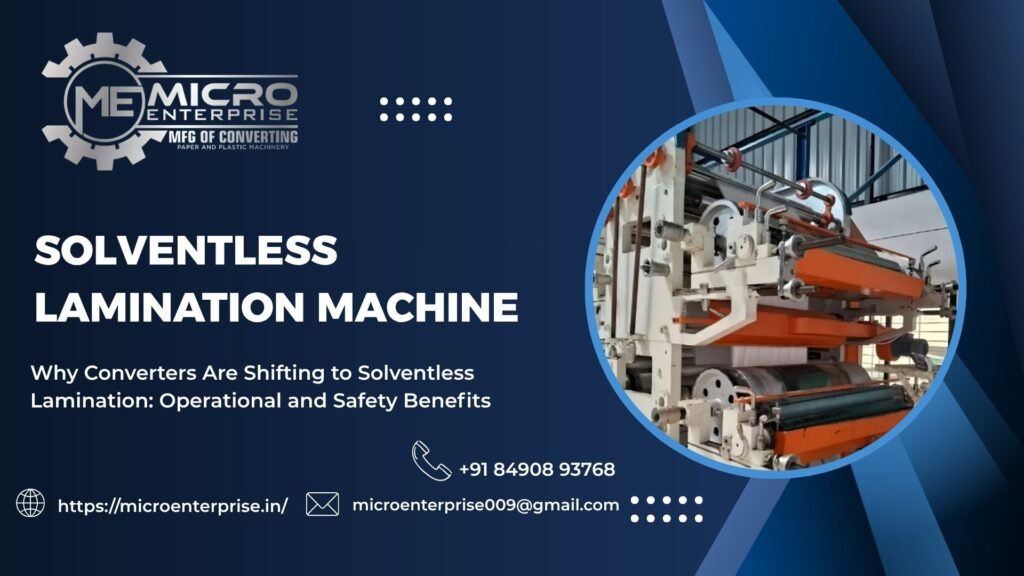
Why Converters Are Shifting to Solventless Lamination: Operational and Safety Benefits
In modern flexible packaging manufacturing, eco-friendly food pouch converting, sustainable pharmaceutical barrier film production, and high-volume multi-layer lamination, environmental sustainability and energy efficiency are critical operational priorities. Traditional solvent-based lamination technologies require immense thermal energy inputs to evaporate volatile organic solvents and demand complex exhaust incineration or recovery units to meet environmental air quality regulations.
Achieving high-speed multi-layer composite film bonding with zero carbon emissions and zero volatile solvent hazards depends fundamentally on the technology of an advanced Solventless Lamination Machine.
An industrial solventless laminator incorporates high-precision multi-roll coating sleeves, heated adhesive metering units, automatic two-component polyurethane dosing mixers, temperature-controlled combining nip assemblies, and sensitive closed-loop web tension controls designed for 100% solid liquid adhesives.
Attempting to meet stringent food safety standards and carbon reduction targets using legacy solvent-borne laminators presents high electrical energy costs, explosion hazards, residual solvent food odor contamination, regulatory compliance risks, and slow operating speeds. Understanding the core theoretical mechanics governing 100% solid polyurethane chemical reaction kinetics, micro-layer transfer rheology, low-tension web handling, and thermal energy elimination enables converting engineers to maximize operational transition benefits. This comprehensive technical guide provides an in-depth theoretical analysis of why flexible packaging converters are shifting to solventless lamination for operational and safety advantages.
Theoretical Dynamics of Solventless Adhesive Transfer and Chemical Curing
Solventless lamination utilizes 100% liquid reactive adhesives applied in micro-thin layers without volatile carrier solvents, completely eliminating thermal drying tunnels:
+-----------------------------------------------------------------+
|                   TWO-COMPONENT POLYURETHANE ADHESIVE MIXING    |
| (100% solid liquid Isocyanate & Polyol components mix precisely)|
+-----------------------------------------------------------------+
                                  |
                                  v
+-----------------------------------------------------------------+
|             HIGH-PRECISION MULTI-ROLL MICRO-LAYER METERING     |
| (Heated metering rolls apply ultra-thin coat weight to web)     |
+-----------------------------------------------------------------+
                                  |
                                  v
+-----------------------------------------------------------------+
|             HEATED NIP COMBINING & AMBIENT CHEMICAL CURING      |
| (Secondary web nip-bonds instantly; polymers cross-link naturally)|
+-----------------------------------------------------------------+
1. 100% Solid Micro-Layer Coating Mechanics
Theoretical Principle: Solventless lamination adhesives contain no water or organic solvents. Because the adhesive is 100% active liquid resin, coating weights applied to film webs are extremely thin compared to solvent-borne liquid formulations.
Multi-Roll Fluid Metering Hydrodynamics: Transferring micro-thin liquid adhesive films uniformly requires a series of precision ground, heated steel and rubber rolls rotating at differential surface speeds. This multi-roll stack shears and thins the viscous liquid resin gradually, laying down a perfectly smooth, bubble-free adhesive layer on the substrate.
2. Polyurethane Polymerization and Chemical Cross-Linking Kinetics
Theoretical Principle: Unlike solvent adhesives that harden through solvent evaporation, solventless adhesives bond through chemical reaction. Two-component polyurethanes (Isocyanate monomer and Polyol resin) undergo polyaddition polymerization after combining at the heated nip.
Ambient Cross-Linking Advantage: Chemical cross-linking occurs inside the wound roll at ambient or heated curing room temperatures over a controlled incubation period. This eliminates thermal drying tunnels entirely, drastically reducing floor space requirements and electrical energy consumption.
Comprehensive Analysis of Operational and Safety Benefits
Transitioning to solventless lamination machinery delivers transformative technical, environmental, and financial advantages for modern converting plants:
Elimination of Residual Solvent Contamination: Operating without organic solvents guarantees zero residual solvent retention in laminated films, fully eliminating foul odors, taste alteration, and food safety compliance failures in food packaging.
Complete Removal of Explosion and Fire Hazards: Operating 100% solvent-free liquid chemistry removes flammable solvent vapors from the plant atmosphere, eliminating explosion risks and significantly lowering insurance premiums.
Drastic Reduction in Thermal Energy Consumption: Eliminating long hot-air drying hoods reduces electrical energy consumption massively, lowering operating costs and cutting carbon emissions.
High-Speed Production Throughput and Compact Footprint: Operating without drying speed bottlenecks allows solventless laminators to process webs at high linear line speeds while occupying a fraction of the floor space required by solvent drying tunnels.
System Integration Across Tape & Film Machinery Infrastructure
Solventless lamination machinery serves as a modern, sustainable web combining platform within advanced converting plants:
Sustainable Solventless Web Combining: High-efficiency multi-layer film bonding, precision 100% solid adhesive metering, and zero-emission processing are executed on a Solventless Lamination Machine.
High-Barrier Solvent Lamination Systems: Heavy-duty solvent-borne adhesive lamination and drying tunnel management are handled on a Solvent-base Lamination Machine.
Master Roll Adhesive Coating Technology: Precision pressure-sensitive adhesive coating, thermal drying, and master log building are managed on a BOPP Tape Coating Machine.
Master Log Roll Slitting Equipment: Converting master film rolls into narrow commercial tape coils using high-speed log cutting is handled on a BOPP Tape Slitting Machine.
Precision Tape Slicing Equipment: Clean, burr-free slicing of specialty tape logs using cooled circular blades is performed on a PVC / Masking Slicer Machine.
Theoretical Best Practices for Solventless Laminator Optimization
To achieve flawless optical transparency, maintain high initial green bond strength, and maximize line efficiency, converting engineers follow three core theoretical guidelines:
Maintain Precise Temperature Regulation Across Metering Rolls: Utilize individual water-circulating temperature control units for each coater roll to maintain constant adhesive temperature and viscosity throughout production runs.
Utilize Automatic Dynamic Mix-Ratio Metering Pumps: Connect precision gear dosing pumps to monitor and maintain exact chemical mixing ratios between monomer and resin components continuously.
Calibrate Unwind and Rewind Tension Profiles for Thin Films: Implement ultra-sensitive load cell dancer controls on film unwind and rewind stations to prevent thermal or mechanical stretching of light-gauge polyethylene or barrier films.
Conclusion
Understanding the theoretical mechanics of 100% solid fluid metering, polyurethane polymerization kinetics, ambient chemical cross-linking, and low-tension web transport is essential for realizing the full advantages of solventless lamination. By eliminating drying tunnels, removing volatile explosion hazards, preventing food contamination, and drastically reducing energy consumption, flexible packaging converters achieve eco-friendly compliance, superior multi-layer film quality, and maximum manufacturing profitability.
Looking for Eco-Friendly Solventless Lamination and Converting Machinery? Explore our complete range of advanced Solventless Lamination Machine models, heavy-duty Solvent-base Lamination Machine units, high-capacity BOPP Tape Coating Machine setups, high-speed BOPP Tape Slitting Machine systems, and precision PVC / Masking Slicer Machine setups at Micro Enterprise. Contact our expert engineering team today.
 Users Today : 5
 Users This Month : 290
 Total Users : 3413