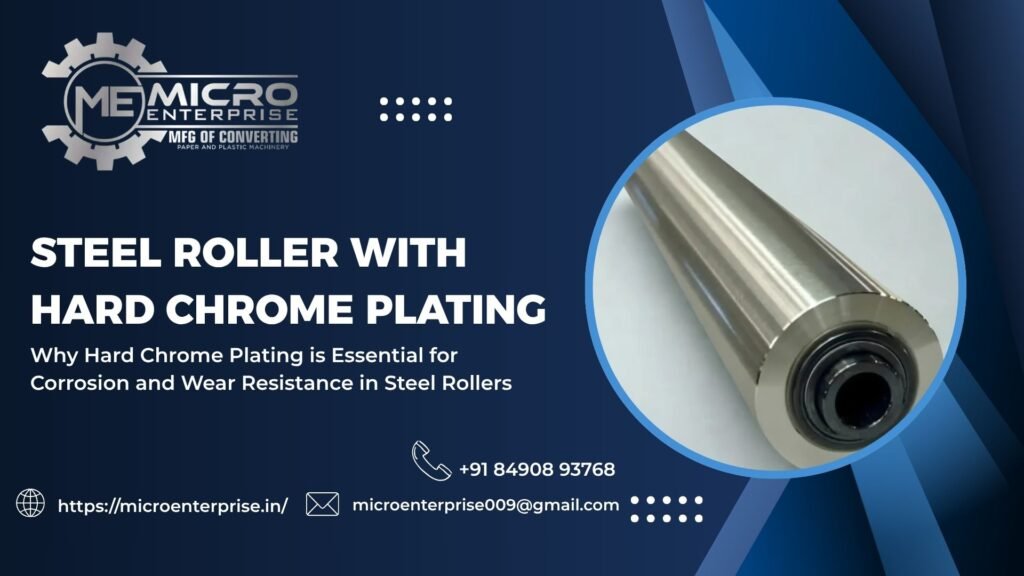
Why Hard Chrome Plating is Essential for Corrosion and Wear Resistance in Steel Rollers
In modern paper converting, flexible film extruding, rotogravure printing, textile finishing, and high-speed web slitting machinery, guide rollers are subjected to continuous mechanical abrasive friction, high rotational speeds, and corrosive chemical environments. Bare steel rollers exposed to atmospheric moisture, acidic inks, solvent vapors, or abrasive substrates rapidly suffer surface degradation.
Ensuring dimensional accuracy, mirror-smooth web transport, and extreme surface durability across web lines depends fundamentally on the engineering performance of a Steel Roller (Hard Chrome Plated).
An industrial hard chrome-plated steel roller incorporates a high-tensile seamless steel pipe core, precision-ground journal stubs, dynamically balanced interior hubs, electro-deposited industrial chromium plating, and mirror-polished or matte micro-finishes designed for severe industrial environments.
Operating web converting lines with untreated bare steel or sub-standard coated rollers leads to rapid surface scoring, localized pitting corrosion, web scratching, rust flaking, premature roller diameter wear, rotational imbalance, and costly frequent roll replacements. Understanding the core theoretical mechanics governing electro-chemical chromium deposition, surface micro-hardness enhancement, tribological friction reduction, and passivation barrier protection enables converting engineers to optimize roller specifications. This comprehensive technical guide provides an in-depth theoretical analysis of why hard chrome plating is essential for corrosion and wear resistance in industrial steel rollers.
Theoretical Metallurgy of Electro-Deposited Hard Chrome and Surface Protection
Hard chrome plating involves electrochemically depositing a metallic chromium layer directly onto precision-ground steel roller surfaces:
+-----------------------------------------------------------------+
|                   PRECISION GROUND STEEL ROLLER CORE            |
| (Seamless steel pipe turned and ground to exact concentricity)  |
+-----------------------------------------------------------------+
                                  |
                                  v
+-----------------------------------------------------------------+
|             ELECTRO-CHEMICAL CHROMIUM BATH DEPOSITION           |
| (Chromium ions bond molecularly, forming micro-crack layer)     |
+-----------------------------------------------------------------+
                                  |
                                  v
+-----------------------------------------------------------------+
|             MIRROR POLISHING & CORROSION-WEAR BARRIER           |
| (Super-finishing creates low-friction, ultra-hard outer skin)  |
+-----------------------------------------------------------------+
1. Electrochemical Chromium Deposition and Micro-Hardness Enhancement
Theoretical Principle: Hard chrome plating deposits a crystalline layer of metallic chromium onto a steel substrate through an electrolytic bath containing chromic acid. Unlike decorative chrome, industrial hard chrome is applied in substantial thickness to transform surface mechanical properties.
Micro-Hardness Kinetics: The deposited chromium structure achieves exceptional surface hardness (reaching up to 65–70 HRC). This crystalline lattice layer shields the underlying steel core against scratch deformation, abrasive paper fiber erosion, and metallic web contact wear.
2. Passivation Oxide Barrier and Tribological Friction Reduction
Theoretical Principle: Chromium naturally reacts with atmospheric oxygen to form a microscopic, self-healing chromium oxide passive film across the outer roller surface.
Corrosion Resistance and Low Surface Energy: This passive oxide film acts as an impenetrable chemical barrier, preventing oxygen, moisture, solvents, and acidic chemical agents from reaching the reactive steel core. Additionally, hard chrome exhibits an extremely low coefficient of friction, reducing web drag, static buildup, and surface scuffing during high-speed web travel.
Comprehensive Analysis of Hard Chrome Roller Quality Parameters
Evaluating hard chrome-plated steel rollers for high-speed machinery applications requires harmonizing metallurgical plating properties with mechanical finishing parameters:
Controlled Micro-Crack Density for Lubricant Retention: High-quality industrial chrome plating features a controlled microscopic crack network that stress-relieves the plated layer, preventing macro-flaking while holding micro-thin fluid films when required.
Sub-Micron Surface Finish Polishing (RA Values): Precision grinding followed by super-finishing yields ultra-smooth surface roughness (low Ra values), preventing delicate plastic films from scratching or marking during contact transport.
Dynamic Balancing at Operating Speeds: Balancing finished rollers dynamically eliminates centrifugal vibration at high rotational speeds, preserving bearing life and maintaining uniform web contact tension.
Uniform Plating Thickness Distribution: Maintaining consistent plating thickness across the entire face width prevents localized diameter variations, ensuring parallel web tracking and zero web creasing.
System Integration Across Machinery & Converting Infrastructure
A heavy-duty hard chrome-plated steel roller serves as a primary web support and transport element across a wide range of industrial equipment:
Hardened Surface Rollers: Maximum wear and corrosion resistance across web path rollers are provided by a Steel Roller (Hard Chrome Plated).
Pneumatic Edge Scrap Removal: Continuous suction transport and trim evacuation on converting lines are handled by a Trimming Blower System.
Web Path Reversal & Angle Turning: Changing web directions and reversing printing sides precisely are managed on a Turnbar System.
Automated Pallet Wrapping: High-efficiency stretch wrapping and load containment are executed using a Stretch Wrapping Machine.
Hydraulic System Power: Fluid pressure generation and hydraulic actuator drives are powered by a heavy-duty Power Pack.
Core Gripping & Mandrel Expansion: Slip-free core locking and roll support during winding are provided by Air Shafts.
Elastomeric Nip Rollers: Controlled pressure nip application and surface friction drive are handled using Rubber Rollers.
High-Speed Printing Mandrels: Vibration-free, dynamically balanced cylinder holding is achieved using precision Cylinder Shafts.
Mechanical Power Transmission: Synchronized drive torque distribution across machinery sections is delivered via Line Shafts.
Low-Inertia Web Support: Fast rotational response and smooth film guiding without drag are ensured by Aluminium Guide Rollers.
Material Handling Conveying: Efficient product and package transport lines are supported by heavy-duty Conveyor Rollers.
Core Slicing Equipment: Burr-free precision cutting of paper and cardboard cores is performed on an automated Paper Core Cutting Machine.
Theoretical Best Practices for Hard Chrome Roller Optimization
To maximize roller operational lifespan, maintain surface finish integrity, and prevent web defects, converting engineers follow three core theoretical guidelines:
Inspect Roller Surfaces for Micro-Pitting and Scratches: Examine roller face surfaces periodically under magnification to detect localized impact damage or chemical pitting before rust propagates under the plating layer.
Utilize Non-Abrasive Cleaning Solvents: Clean hard chrome rollers using soft cloths and non-abrasive chemical solvents to remove ink, adhesive residue, and dust without dulling the polished surface finish.
Ensure Parallel Roller Alignment in Machine Frames: Verify that roller journals sit in precise parallel alignment across machine frames to prevent localized web tension concentration and uneven bearing wear.
Conclusion
Understanding the theoretical mechanics of electrochemical chromium deposition, surface micro-hardness enhancement, passivation oxide barrier formation, and low-friction surface kinetics is essential for selecting guide rollers. By specifying hard chrome-plated steel rollers, maintaining low surface roughness finishes, ensuring uniform plating thickness, and verifying dynamic balancing, web converting operations eliminate web scratching, prevent corrosion failure, and maximize machinery service longevity.
Looking for Industrial Equipment and Machinery Components?
Explore our complete range of specialized machinery solutions including durable Steel Roller (Hard Chrome Plated) units, pneumatic Trimming Blower System units, precise Turnbar System setups, automated Stretch Wrapping Machine models, heavy-duty Power Pack units, expanding Air Shafts, resilient Rubber Rollers, high-precision Cylinder Shafts, synchronized Line Shafts, low-inertia Aluminium Guide Rollers, heavy-duty Conveyor Rollers, and precise Paper Core Cutting Machine units at Micro Enterprise. Contact our expert engineering team today.
 Users Today : 5
 Users This Month : 290
 Total Users : 3413