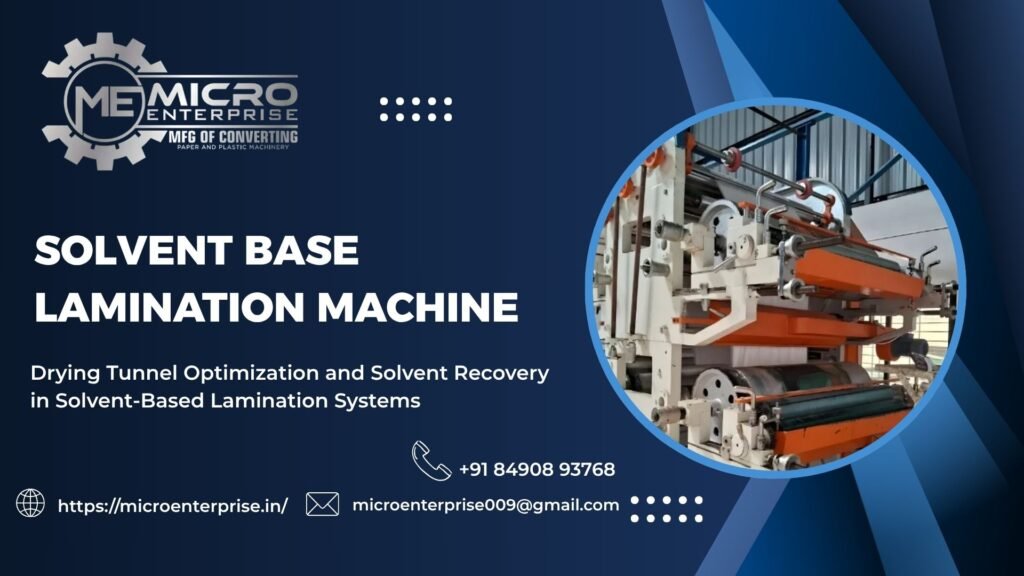
Drying Tunnel Optimization and Solvent Recovery in Solvent-Based Lamination Systems
In high-barrier flexible packaging, retort pouch manufacturing, pharmaceutical foil lamination, and heavy-duty industrial film converting, multi-layer composite structures are essential for protecting perishable products. Combining distinct polymer films—such as PET, BOPP, aluminum foil, and polyethylene—using solvent-borne polyurethane or acrylic adhesives ensures high bond strength, optical clarity, and chemical resistance.
Achieving high-strength composite bonding without residual solvent odor or substrate heat distortion depends fundamentally on the engineering sophistication of an advanced Solvent-base Lamination Machine.
An industrial solvent-based laminator incorporates gravure coating stations, multi-zone thermal drying tunnels, heated nip lamination rollers, active lower explosive limit (LEL) monitoring sensors, integrated solvent recovery/incineration units, and automated web tension compensators.
Operating solvent-based lamination equipment without optimizing drying tunnel air velocity and thermal gradients leads to severe residual solvent retention, web skinning bubbles, low bond strength, delamination, web heat stretching, and high volatile organic compound (VOC) emissions. Understanding the core theoretical mechanics governing volatile solvent mass transfer, thermal boundary layer turbulence, polymer web heat transfer, and carbon-adsorption solvent recovery enables converting engineers to optimize lamination performance. This comprehensive technical guide provides an in-depth theoretical analysis of drying tunnel optimization and solvent recovery in solvent-based lamination systems.
Theoretical Dynamics of Solvent Evaporation and Thermal Drying Kinetics
Solvent-based lamination relies on applying liquid adhesive dissolved in organic solvents onto a primary substrate, flashing off all solvent vehicle within a multi-zone drying tunnel, and bonding it to a secondary web under heat and pressure:
+-----------------------------------------------------------------+
|                   PRIMARY SUBSTRATE SOLVENT ADHESIVE COATING     |
| (Gravure coater applies uniform wet solvent-borne adhesive layer)|
+-----------------------------------------------------------------+
                                  |
                                  v
+-----------------------------------------------------------------+
|             MULTI-ZONE THERMAL DRYING TUNNEL EVAPORATION        |
| (High-velocity hot air flashes solvent vehicle without skinning)|
+-----------------------------------------------------------------+
                                  |
                                  v
+-----------------------------------------------------------------+
|             HEATED NIP COMBINING & VOC SOLVENT RECOVERY         |
| (Dry adhesive nip-bonds to secondary web; exhaust air recovers VOC)|
+-----------------------------------------------------------------+
1. Boundary Layer Mass Transfer and Solvent Evaporation Kinetics
Theoretical Principle: The rate at which volatile solvents (such as ethyl acetate or methyl ethyl ketone) evaporate from wet adhesive layers is governed by thermal convection and mass transfer across the fluid boundary air layer.
Skinning and Solvation Trapping Hazard: If initial drying zones apply excessively high temperatures, the top surface of the adhesive layer dries rapidly and forms a dense polymer “skin.” This skin traps underlying liquid solvent, leading to solvent retention, foul odor in food packaging, and severe loss of final bond strength.
2. Solvent Recovery Thermodynamics and Environmental Closed-Loop Kinetics
Theoretical Principle: Evaporated solvent vapors carried away by hot tunnel exhaust air present environmental hazard and economic waste. Integrated solvent recovery systems route exhaust air through activated carbon adsorption beds or nitrogen-condensation units.
VOC Adsorption and Circular Recovery: Carbon beds adsorb organic solvent molecules from the air stream. Subsequent steam regeneration desorbs the solvent, which is condensed, distilled, and recovered at high purity for re-use in ink and adhesive blending, creating an eco-friendly closed-loop manufacturing system.
Comprehensive Analysis of Laminator Operational Parameters
Optimizing solvent-based lamination systems requires balancing thermal drying parameters with safety and environmental controls:
Multi-Stage Graduated Temperature Tunnel Profiles: Configuring initial drying zones at moderate temperatures allows gradual solvent release, while final higher-temperature zones complete cross-linking without trapping residual volatile molecules.
High-Velocity Impingement Air Nozzle Aerodynamics: Utilizing staggered, high-velocity hot air nozzles breaks the stagnant boundary air layer above the wet adhesive, accelerating mass transfer without disturbing fluid coating uniformity.
Heated Steel Lamination Nip Pressure Calibration: Regulating temperature and hydraulic pressure across the combining nip ensures full contact between the tacky dried adhesive and secondary substrate web, eliminating air entrapment.
LEL Gas Sensor Interlocks and Exhaust Recirculation: Integrating continuous Lower Explosive Limit (LEL) sensors regulates exhaust fan volumes automatically, maintaining safe solvent-to-air concentrations well below explosive limits.
System Integration Across Tape & Film Machinery Infrastructure
Solvent-based lamination machinery serves as a primary multi-layer substrate combining station within advanced converting plants:
High-Barrier Solvent Lamination Technology: Precision solvent adhesive coating, multi-zone thermal drying, and solvent recovery integration are executed on a heavy-duty Solvent-base Lamination Machine.
Eco-Friendly Solventless Lamination: High-efficiency multi-layer web combining using 100% solid solvent-free adhesives is handled on a Solventless Lamination Machine.
High-Capacity Master Tape Coating: Precision pressure-sensitive adhesive coating, thermal drying, and master log building are managed on a BOPP Tape Coating Machine.
Master Log Roll Slitting Systems: Converting master adhesive film rolls into narrow commercial tape coils using high-speed log cutting is handled on a BOPP Tape Slitting Machine.
Precision Tape Slicing Equipment: Clean, burr-free slicing of specialty tape logs using cooled circular blades is performed on a PVC / Masking Slicer Machine.
Theoretical Best Practices for Solvent Lamination Optimization
To eliminate residual solvent odor, ensure high bond lamination strength, and maximize recovery efficiency, converting engineers follow three core theoretical guidelines:
Conduct Gas Chromatography Residual Solvent Testing: Test laminated film samples periodically using gas chromatography to verify that residual solvent levels remain far below international food safety thresholds.
Optimize Air Recirculation Ratios in Drying Tunnels: Balance fresh air intake and recirculated air ratios within drying hoods to maximize thermal energy efficiency while maintaining high solvent evaporation rates.
Monitor Activated Carbon Bed Saturation: Inspect and regenerate carbon adsorption beds systematically to maintain peak volatile organic compound (VOC) recovery efficiency and prevent atmospheric emissions.
Conclusion
Understanding the theoretical mechanics of solvent evaporation mass transfer, skinning prevention, boundary layer turbulence, and closed-loop carbon adsorption solvent recovery is essential for optimizing solvent-based lamination operations. By programming graduated drying tunnel temperature profiles, maintaining high nozzle air velocities, regulating combining nip pressure, and managing integrated VOC recovery systems, flexible packaging converters deliver high-barrier multi-layer films, protect the environment, and maximize operational productivity.
Looking for Advanced Lamination and Converting Machinery? Explore our complete range of heavy-duty Solvent-base Lamination Machine models, eco-friendly Solventless Lamination Machine units, high-capacity BOPP Tape Coating Machine setups, high-speed BOPP Tape Slitting Machine systems, and precision PVC / Masking Slicer Machine setups at Micro Enterprise. Contact our expert engineering team today.
 Users Today : 5
 Users This Month : 290
 Total Users : 3413