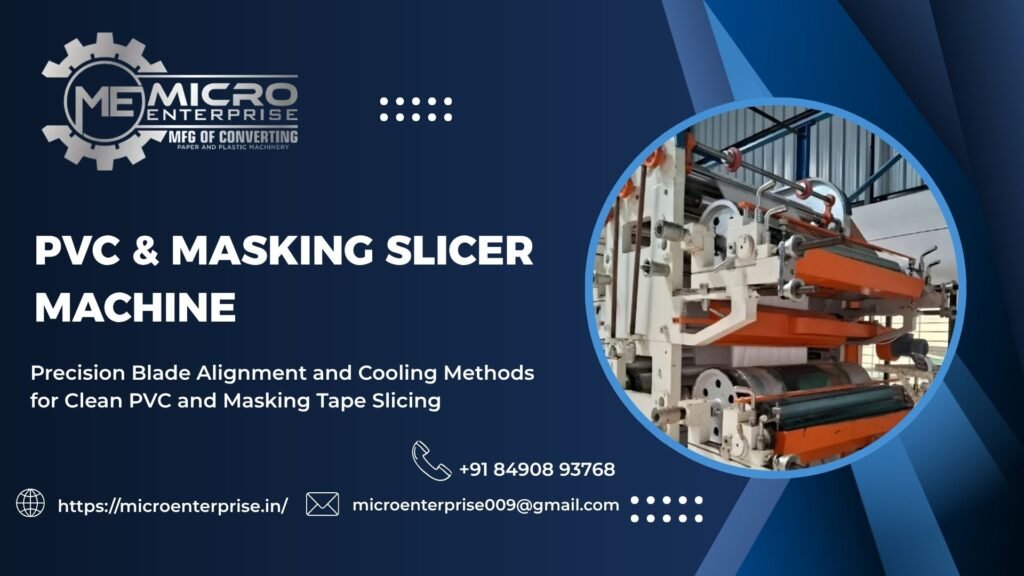
Precision Blade Alignment and Cooling Methods for Clean PVC and Masking Tape Slicing
In electrical insulation manufacturing, automotive paint masking, construction tape converting, and industrial surface protection applications, PVC electrical tapes and crepe paper masking tapes serve critical roles. Slicing master logs of flexible polyvinyl chloride (PVC) film or textured crepe paper coated with natural rubber or hot-melt adhesives demands distinct mechanical considerations compared to standard plastic packaging films.
Achieving mirror-smooth side wall finishes, square roll edge profiles, and zero adhesive contamination depends fundamentally on the engineering precision of an advanced PVC / Masking Slicer Machine.
An industrial PVC and masking tape slicer incorporates high-rigidity linear guide rails, servo-driven circular blade penetration axes, mist cooling/lubrication injectors, programmable log indexing mandrels, and laser blade alignment sensors engineered for sensitive tape log slicing.
Operating tape slicing machinery without precise blade axial alignment and adequate thermal cooling causes severe PVC elastic edge deformation, crepe paper edge crushing, blade gumming, adhesive bleed, telescoping roll faces, and high scrap rates. Understanding the core theoretical mechanics governing polymer plasticizer interaction, paper fiber shear fracture, thermal friction dissipation, and blade axial run-out suppression enables converting engineers to optimize slicing quality. This comprehensive technical guide provides an in-depth theoretical analysis of precision blade alignment and cooling methods for clean PVC and masking tape slicing.
Theoretical Dynamics of Substrate Behavior and Slicing Mechanics
Slicing PVC and masking tape logs involves penetrating a high-speed rotating circular blade through soft elastomeric films or fibrous paper matrices:
+-----------------------------------------------------------------+
|                   PVC OR MASKING TAPE LOG MOUNTING              |
| (Log locks onto pneumatic expanding mandrel with solid support) |
+-----------------------------------------------------------------+
                                  |
                                  v
+-----------------------------------------------------------------+
|             LASER-ALIGNED BLADE PENETRATION & MIST COOLING      |
| (Cooled circular blade penetrates log along exact axial angle)  |
+-----------------------------------------------------------------+
                                  |
                                  v
+-----------------------------------------------------------------+
|             BURR-FREE EDGE SEPARATION & PRISTINE FINISH         |
| (Friction-free cut yields clean, non-tacky, square-edged rolls) |
+-----------------------------------------------------------------+
1. Substrate Deformation Mechanics: PVC vs. Crepe Paper
Theoretical Principle: Soft PVC electrical tapes contain plasticizers that make the polymer elastic and heat-sensitive. Under blade penetration pressure, uncooled blades cause localized elastic stretching, causing edge roll dishing and plasticizer migration that degrades adhesive tack.
Crepe Paper Shear Mechanics: Crepe paper masking tapes consist of fibrous, expandable paper bases. Imprecise blade alignment or dull knife edges crush paper fibers rather than shearing them cleanly, resulting in fuzzy, frayed roll edges and adhesive bleeding across the cut face.
2. Blade Axial Alignment and Thermal Dissipation Mechanics
Theoretical Principle: Maintaining zero axial deflection (run-out) during blade movement is vital. If the circular blade tilts slightly relative to the log axis, lateral friction forces increase exponentially, causing thermal buildup and wedge distortion.
Fluid Mist Boundary Cooling: Injecting a fine mist of water-soluble lubricant or silicone emulsion directly onto the blade-to-tape contact interface creates a protective hydrodynamic film. This film dissipates frictional heat instantly, keeping blade temperatures low enough to prevent PVC melting and rubber adhesive degradation.
Comprehensive Analysis of Slicer Operational Parameters
Optimizing PVC and masking tape slicing machinery requires harmonizing mechanical knife positioning with substrate chemical characteristics:
Sub-Micron Axial Blade Alignment Calibration: Utilizing laser alignment systems ensures the circular blade enters the tape log at an exact perpendicular angle, eliminating lateral blade rub and roll side wall distortion.
Controlled Blade Penetration Velocity Programming: Programming a multi-stage penetration speed—slower when piercing outer film layers and accelerating through internal cores—prevents log distortion and ensures clean core cuts.
Continuous Blade Lubrication Spray Management: Regulating lubricant spray mists prevents adhesive buildup on the blade steel while avoiding excess fluid saturation that could damage cardboard cores.
Pneumatic Log Mandrel Clamping Rigidity: Securing the internal log core with uniform pneumatic expansion prevents log vibration and chatter during deep high-speed knife penetration.
System Integration Across Tape & Film Machinery Infrastructure
PVC and masking tape slicers operate alongside a comprehensive suite of material converting and coating equipment:
Precision Tape Slicing Technology: Burr-free log slicing, laser blade alignment, and fluid blade cooling are executed on a PVC / Masking Slicer Machine.
High-Speed BOPP Log Slitting: Converting master film rolls into narrow tape coils using high-speed log cutting is handled on a BOPP Tape Slitting Machine.
Master Roll Adhesive Coating: Precision pressure-sensitive adhesive application, thermal drying, and master log building are managed on a BOPP Tape Coating Machine.
Solvent-Based Web Lamination: High-barrier multi-layer substrate bonding using solvent-borne adhesives is managed on a Solvent-base Lamination Machine.
Eco-Friendly Solventless Lamination: High-efficiency multi-layer web combining using 100% solid solvent-free adhesives is executed on a Solventless Lamination Machine.
Theoretical Best Practices for Tape Slicer Optimization
To achieve mirror-smooth side walls, prevent adhesive smearing, and extend blade life, converting engineers follow three core theoretical guidelines:
Utilize Ultra-Fine Grain Carbide Circular Blades: Specify micro-grain tungsten carbide circular blades with polished mirror finishes to reduce surface friction drag and prevent adhesive adhesion.
Implement Dual-Side Fluid Mist Injection: Position twin cooling nozzles to spray lubricant mists onto both the leading and trailing bevel faces of the circular blade simultaneously.
Inspect Blade Edge Geometry Regularly: Monitor circular blade sharpness and micro-chipping under magnification, regrinding edges immediately when bevel wear threatens shear cut precision.
Conclusion
Understanding the theoretical mechanics of elastomeric deformation, paper fiber shear fracture, friction heat dissipation, and axial blade alignment is essential for achieving clean cuts during PVC and masking tape slicing. By maintaining precise perpendicular blade angles, deploying automated fluid mist cooling systems, programming controlled penetration rates, and utilizing high-rigidity log mandrels, tape converters produce pristine, market-ready tape rolls with crisp edge profiles and high operational efficiency.
Looking for Specialized Tape Slicing and Converting Machinery? Explore our complete range of precision PVC / Masking Slicer Machine models, high-speed BOPP Tape Slitting Machine units, high-capacity BOPP Tape Coating Machine setups, heavy-duty Solvent-base Lamination Machine systems, and eco-friendly Solventless Lamination Machine setups at Micro Enterprise. Contact our expert engineering team today.
 Users Today : 5
 Users This Month : 290
 Total Users : 3413