
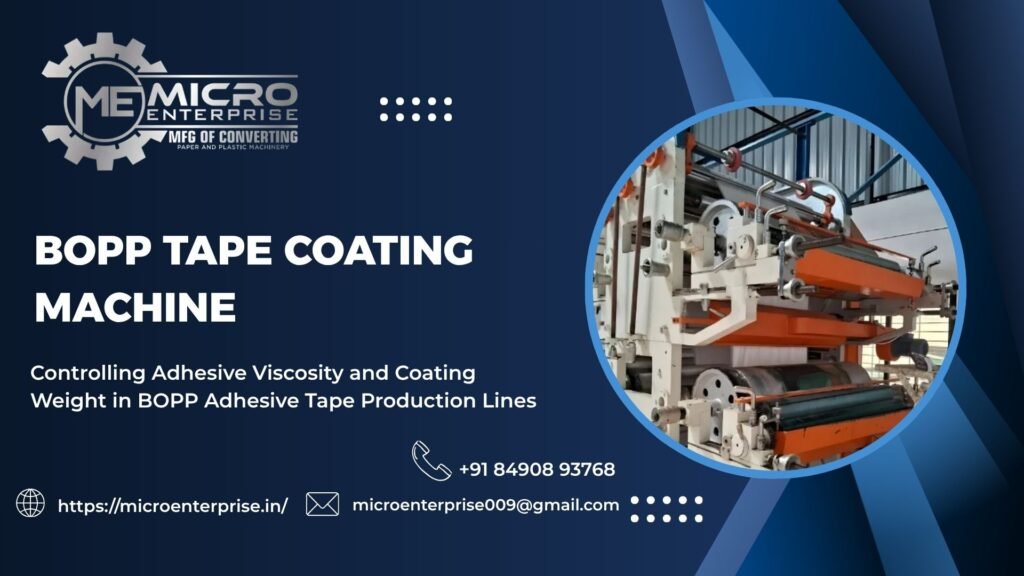
Controlling Adhesive Viscosity and Coating Weight in BOPP Adhesive Tape Production Lines
In global industrial packaging, commercial carton sealing, logistics labeling, and pressure-sensitive adhesive tape manufacturing, Biaxially Oriented Polypropylene (BOPP) adhesive tape is a ubiquitous packaging material. High-performance BOPP tape production requires applying precise, microscopic layers of pressure-sensitive adhesive (PSA)—such as water-based acrylic, solvent-based acrylic, or hot-melt rubber—onto continuous, ultra-thin BOPP film backings.
Achieving uniform tack, consistent shear strength, and flawless optical transparency depends fundamentally on the engineering accuracy of an advanced BOPP Tape Coating Machine.
An industrial BOPP tape coating line incorporates high-speed unwind stands, reverse roll or gravure coater heads, multi-zone thermal drying tunnels, automatic edge position controllers, thickness sensing arrays, and heavy-duty surface rewinders designed for continuous chemical application.
Operating tape coating lines without controlling adhesive fluid rheology and drying evaporation rates leads to severe coating weight variations, adhesive ridging, telegraphing, incomplete drying bubbles, adhesive transfer failure (delamination), and low tack performance. Understanding the core theoretical mechanics governing fluid viscosity shear rate behavior, metering gap fluid dynamics, thermal boundary-layer solvent/water evaporation, and chemical surface energy anchorage enables converting engineers to optimize coating precision. This comprehensive technical guide provides an in-depth theoretical analysis of controlling adhesive viscosity and coating weight in BOPP adhesive tape production lines.
Theoretical Dynamics of Adhesive Coating Mechanics and Viscosity Rheology
Adhesive tape manufacturing relies on precise fluid metering, uniform wet film laydown, and controlled thermal moisture/solvent removal across moving film webs:
+-----------------------------------------------------------------+
|                   BOPP BASE FILM PRE-TREATMENT & INFEED          |
| (Corona-treated BOPP film enters high-speed coating station)    |
+-----------------------------------------------------------------+
                                  |
                                  v
+-----------------------------------------------------------------+
|             PRECISION REVERSE ROLL ADHESIVE METERING            |
| (Metering roll applies controlled wet adhesive coat weight)     |
+-----------------------------------------------------------------+
                                  |
                                  v
+-----------------------------------------------------------------+
|             MULTI-ZONE THERMAL DRYING & FILM ANCHORAGE          |
| (Graduated hot air zones evaporate moisture/solvent vehicle)    |
+-----------------------------------------------------------------+
1. Fluid Rheology and Reverse Roll Metering Dynamics
Theoretical Principle: Pressure-sensitive adhesives exhibit non-Newtonian, shear-thinning fluid rheology. During high-speed coating, fluid viscosity changes dynamically under high shear forces generated within the narrow metering gap between precision ground steel rolls.
Coat Weight Stability: Maintaining stable adhesive viscosity ensures consistent fluid hydraulic pressure inside the coating nip. If adhesive viscosity fluctuates due to temperature variations or improper mixing, the fluid film split behavior changes, causing unwanted transverse coat weight waves and streaking.
2. Thermal Boundary-Layer Evaporation and Chemical Anchorage
Theoretical Principle: Once wet adhesive is applied onto corona-treated BOPP film, the coated web enters a multi-zone thermal drying tunnel. High-velocity hot air impingement evaporates the water or solvent carrier vehicle without boiling the adhesive matrix.
Adhesive Anchorage Mechanics: Corona treatment increases the surface energy of the non-polar BOPP film. Controlled drying allows polymer adhesive chains to interlock mechanically and chemically with the activated film surface, establishing high anchorage strength that prevents adhesive transfer when unwinding finished tape rolls.
Comprehensive Analysis of Coating Quality Parameters
Optimizing BOPP tape coating lines requires harmonizing fluid chemical properties with mechanical web transport controls:
Metering Gap Hydraulic Pressure Calibration: Maintaining precise micro-clearances between precision coater rolls governs wet coating thickness, preventing adhesive ridges and edge bead accumulation.
Multi-Zone Temperature Gradient Control: Applying a graduated thermal profile—starting with lower temperatures in initial drying zones and rising in final curing stages—prevents skinning, skin entrapment bubbles, and adhesive blistering.
Corona Discharge Surface Energy Optimization: Monitoring corona treatment power ensures film surface dyne levels remain sufficiently elevated above adhesive surface tension, promoting uniform fluid wetting and permanent bond anchorage.
Dynamic Tension Isolation Across Drying Tunnels: Isolating web tension within hot drying hoods prevents thermal film stretching, thermal necking, and longitudinal web wrinkling during high-temperature exposure.
System Integration Across Tape & Film Machinery Infrastructure
BOPP tape coating equipment operates as the primary chemical application asset within specialized tape manufacturing plants:
High-Speed Adhesive Coating Technology: Precision adhesive metering, thermal drying tunnel management, and master roll building are executed on a heavy-duty BOPP Tape Coating Machine.
Master Log Roll Slitting Systems: Converting wide adhesive master rolls into narrow tape coils using high-speed log cutting is handled on a BOPP Tape Slitting Machine.
Precision Tape Slicing Equipment: Clean, burr-free slicing of specialty tape logs using cooled circular blades is performed on a PVC / Masking Slicer Machine.
Solvent-Based Web Lamination: High-barrier multi-layer substrate bonding using solvent-borne adhesives is managed on a Solvent-base Lamination Machine.
Eco-Friendly Solventless Lamination: High-efficiency multi-layer web combining using 100% solid solvent-free adhesives is executed on a Solventless Lamination Machine.
Theoretical Best Practices for Tape Coating Optimization
To eliminate coat weight variations, ensure high adhesive tack, and maximize tape line productivity, chemical and converting engineers follow three core theoretical guidelines:
Implement Closed-Loop Viscosity and Temperature Control: Circulate adhesive through temperature-regulated holding tanks fitted with automated viscometers to maintain constant fluid viscosity throughout production runs.
Utilize Online Beta-Ray or Infrared Coat Weight Sensors: Position continuous non-contact coat weight sensors across the web width immediately after the drying tunnel to detect micro-variations and adjust coater roll gaps dynamically.
Maintain Clean Air Filtration in Drying Tunnels: Inspect and replace high-efficiency particulate air (HEPA) filters regularly in drying hoods to prevent dust particles from settling onto wet adhesive surfaces and spoiling tape transparency.
Conclusion
Understanding the theoretical mechanics of fluid adhesive rheology, reverse roll metering hydraulic pressure, multi-zone thermal drying kinetics, and surface energy anchorage is essential for controlling coat weight and adhesive viscosity in BOPP tape production. By maintaining precise fluid viscosity, optimizing drying temperature gradients, regulating coater roll micro-gaps, and ensuring proper film corona pre-treatment, adhesive tape manufacturers produce high-tack, crystal-clear packaging tapes and maximize operational line efficiency.
Looking for Advanced Tape Coating and Converting Machinery? Explore our complete range of high-capacity BOPP Tape Coating Machine models, high-speed BOPP Tape Slitting Machine units, precision PVC / Masking Slicer Machine setups, heavy-duty Solvent-base Lamination Machine systems, and eco-friendly Solventless Lamination Machine systems at Micro Enterprise. Contact our expert engineering team today.
 Users Today : 5
 Users This Month : 290
 Total Users : 3413