
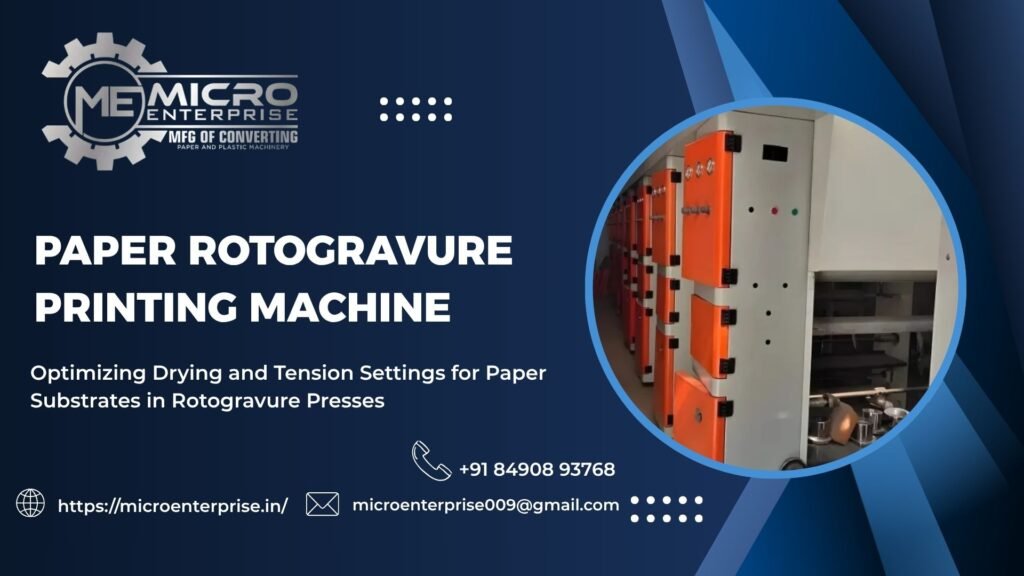
Optimizing Drying and Tension Settings for Paper Substrates in Rotogravure Presses
In high-volume paper packaging production, specialty label converting, gift wrap manufacturing, and decorative paper laminate printing, paper substrates present unique physical behavior compared to non-porous plastic films. Paper webs exhibit fibrous absorbency, directional moisture sensitivity, and hydro-expansive characteristics under thermal and mechanical stress.
Achieving vibrant graphic quality, crisp register accuracy, and wrinkle-free paper travel depends fundamentally on the engineering precision of a specialized Paper Rotogravure Printing Machine.
An industrial paper rotogravure press incorporates heavy-duty unwind stands, high-velocity thermal air drying hoods, precision doctor blade assemblies, water/solvent-based ink circulation units, and closed-loop web tension compensators designed specifically for fibrous substrates.
Operating rotogravure presses on paper substrates without managing thermal drying profiles and web tension leads to severe paper web curling, dimensional hygro-expansion, web tears, fiber picking, ink smudging, and longitudinal misregistration. Understanding the core theoretical mechanics governing ink absorption kinetics, cellulose moisture equilibrium, boundary-layer solvent evaporation, and low-stress web transport enables printing engineers to optimize press settings. This comprehensive technical guide provides an in-depth theoretical analysis of optimizing drying and tension settings for paper substrates in rotogravure presses.
Theoretical Dynamics of Paper Substrate Behavior and Thermal Drying
Printing on paper substrates requires balancing fluid ink absorption with controlled heat application to prevent physical web distortion:
+-----------------------------------------------------------------+
|                   FIBROUS PAPER SUBSTRATE INFEED                |
| (Paper absorbs liquid ink vehicle through capillary action)    |
+-----------------------------------------------------------------+
                                  |
                                  v
+-----------------------------------------------------------------+
|               HIGH-VELOCITY AIR IMPINGEMENT DRYING ZONE         |
| (Hot air flashes ink solvents without over-drying paper fibers)|
+-----------------------------------------------------------------+
                                  |
                                  v
+-----------------------------------------------------------------+
|             STABLE MOISTURE BALANCE & TENSION-CONTROLLED WIND   |
| (Controlled cooling rollers restore web stability before rewind)|
+-----------------------------------------------------------------+
1. Capillary Ink Absorption and Hydro-Expansivity Kinetics
Theoretical Principle: Paper consists of a porous matrix of cellulose fibers. When fluid gravure ink is applied under impression roller nip pressure, the liquid vehicle penetrates paper pores through capillary action.
Hygro-Expansivity Challenge: Absorbing liquid ink vehicle causes cellulose fibers to swell laterally and longitudinally. This localized expansion changes web width and path length between printing stations, causing registration drift unless counteracted by precise web tension control.
2. Thermal Boundary-Layer Evaporation and Moisture Balance
Theoretical Principle: Drying printed ink on paper requires evaporating volatile solvents or water without stripping essential equilibrium moisture from the cellulose fibers. High-velocity hot air nozzles break the boundary air layer on the wet ink surface to flash solvents rapidly.
Over-Drying and Web Brittleness: Exposing paper webs to excessive drying temperatures removes structural fiber moisture, making the paper brittle, prone to edge cracking, and susceptible to static accumulation and severe web curling.
Comprehensive Analysis of Tension and Drying Parameters
Optimizing paper rotogravure printing requires harmonizing mechanical tension control with thermal drying dynamics across all printing stations:
Low-Tension Web Transport Profiles: Maintaining low, stable web tension prevents permanent stretching of wet, weakened paper fibers while passing through impression nips and drying hoods.
Controlled Air Nozzle Velocity and Temperature Modulation: Adjusting hot-air nozzle velocity higher while keeping temperatures moderate ensures rapid solvent evaporation without scorching paper or stripping structural fiber moisture.
Chill Roller Thermal Stabilization: Passing heated paper webs over water-cooled chill rollers immediately after drying hoods stabilizes web temperature, restores moisture balance, and locks in ink adhesion before the next print station.
Closed-Loop Load Cell Tension Compensation: Utilizing closed-loop load cell arrays combined with responsive dancer rollers compensates automatically for minor paper caliper variations and moisture-induced web length changes.
System Integration Across Printing Machinery Infrastructure
Paper rotogravure printing presses function as specialized processing assets within complete material converting facilities:
Dedicated Paper Gravure Printing: High-speed paper printing, thermal drying tunnel control, and low-stretch tension management are executed on a Paper Rotogravure Printing Machine.
General Gravure Printing Systems: Direct cylinder image transfer and multi-color registration control are managed on a Rotogravure Printing Machine.
Fast Ergonomic Cylinder Changing: Rapid shaftless cylinder loading using pneumatic chucking setups is enabled by a Shaftless Printing Machine.
Decorative Foil Stamping: High-precision hot and cold metallic foil transfer onto packaging webs is performed on a Foil Printing Machine.
Flexographic Anilox Printing: Precise fluid ink metering using structured ceramic anilox rolls is managed on a Flexo Printing Machine.
Theoretical Best Practices for Paper Gravure Optimization
To eliminate paper web curling, prevent misregistration, and deliver high-definition print quality, printing engineers follow three core theoretical guidelines:
Balance Air Volume Over Air Temperature in Drying Hoods: Increase drying hood air volume and turbulence rather than temperature to flash solvents efficiently without dehydrating paper fibers.
Implement Graduated Tension Taper Profiles: Apply a slight tension taper along the press length to accommodate natural paper elongation as it absorbs ink and travels through drying stations.
Utilize Moisture Re-humidification at Rewind: Integrate steam or moisture re-humidification units prior to rewind stations when printing heavy paper grades to restore natural fiber flexibility and prevent post-press curling.
Conclusion
Understanding the theoretical mechanics of capillary ink absorption, paper hydro-expansivity, boundary-layer solvent evaporation, and low-stress web transport is essential for optimizing paper rotogravure printing operations. By balancing drying hood air volumes, deploying water-cooled chill rollers, maintaining low web tension profiles, and utilizing closed-loop load cell compensation, paper converters deliver crisp graphic registration, eliminate web distortion, and maximize press productivity.
Looking for Specialized Paper Printing and Converting Machinery? Explore our complete range of high-efficiency Paper Rotogravure Printing Machine models, high-definition Rotogravure Printing Machine units, ergonomic Shaftless Printing Machine systems, precision Foil Printing Machine setups, and versatile Flexo Printing Machine setups at Micro Enterprise. Contact our expert engineering team today.
 Users Today : 5
 Users This Month : 290
 Total Users : 3413