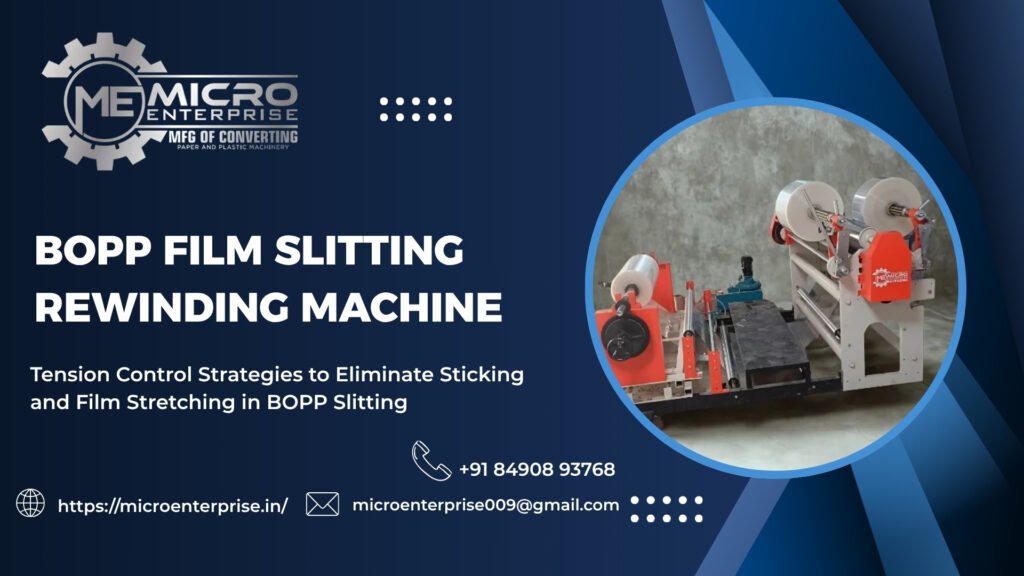
Tension Control Strategies to Eliminate Sticking and Film Stretching in BOPP Slitting
In modern flexible packaging converting, food wrap production, pressure-sensitive adhesive tape manufacturing, and clear lamination film processing, Biaxially Oriented Polypropylene (BOPP) film is a dominant flexible substrate. BOPP film possesses exceptional tensile strength, brilliant optical clarity, low moisture permeability, and high heat-seal capabilities, combined with notable elastic elongation characteristics when subjected to improper mechanical tension.
Achieving high-speed BOPP film converting without optical distortion or roll blocking depends fundamentally on the engineering precision of a specialized BOPP Film Slitting Rewinding Machine.
An industrial BOPP film slitter rewinder incorporates low-inertia guide rollers, active static elimination bars, razor-in-groove slitting assemblies, closed-loop load cell tension controls, differential air friction rewind shafts, and precision lay-on nip rollers engineered to handle elastic polymer films.
Operating film slitter rewinders without managing web tension profiles and electrostatic charges leads to irreversible film necking, permanent web stretching, gauge band buildup, inter-layer film sticking (blocking), gauge-line distortion, and ruined roll clarity. Understanding the core theoretical mechanics governing polymer viscoelasticity, triboelectric charge accumulation, differential friction torque modulation, and boundary air displacement enables converting engineers to optimize BOPP slitting operations. This comprehensive technical guide provides an in-depth theoretical analysis of tension control strategies to eliminate sticking and film stretching in BOPP film slitting rewinding machines.
Theoretical Dynamics of BOPP Viscoelasticity and Anti-Sticking Mechanics
Converting thin BOPP film requires balancing low axial tension forces against electrostatic charge management to prevent elastic deformation and inter-layer blocking:
+-----------------------------------------------------------------+
|                   HIGH-SPEED BOPP FILM UNWIND                   |
| (Ultra-thin elastic film travels under low-tension transport)   |
+-----------------------------------------------------------------+
                                  |
                                  v
+-----------------------------------------------------------------+
|             STATIC NEUTRALIZATION & RAZOR SLITTING ZONE         |
| (Active ionization bars eliminate charges; razor blades slit cleanly)|
+-----------------------------------------------------------------+
                                  |
                                  v
+-----------------------------------------------------------------+
|             DIFFERENTIAL TORQUE TAPER & LAY-ON AIR PURGING      |
| (Differential shafts prevent stretching; lay-on rolls stop blocking)|
+-----------------------------------------------------------------+
1. Polymer Viscoelasticity and Anti-Stretching Mechanics
Theoretical Principle: BOPP film exhibits viscoelastic behavior under mechanical stress. When axial web tension exceeds the material elastic yield threshold, polymer chains uncoil and slide, causing permanent lateral necking and gauge thinning.
Low-Tension Isolation Dynamics: Preventing film stretching requires maintaining extremely low, steady web tension throughout the transport zone. Utilizing dead-shaft, low-inertia carbon fiber rollers minimizes web friction drag, ensuring the film remains within its linear elastic recovery limits without permanent physical deformation.
2. Static Charge Generation and Inter-Layer Film Blocking
Theoretical Principle: High-speed friction between smooth BOPP film and guide rollers generates immense triboelectric static charges. Highly charged film layers attract each other tightly on the rewind roll, squeezing out boundary air completely and creating inter-layer vacuum contact.
Anti-Blocking Air Film Retention: Electrostatic attraction combined with high contact pressure causes thermal and mechanical “blocking,” where film layers stick together permanently. Eliminating blocking requires deploying active ionization bars to neutralize static charges while maintaining controlled, micro-thin air film lubrication between wraps.
Comprehensive Tension Control Strategies for BOPP Slitting
Optimizing BOPP film slitting rewinding machinery requires evaluating advanced mechanical and electronic parameter controls:
Differential Air Friction Shaft Torque Modulation: Utilizing differential friction rewind shafts allows independent core slipping, ensuring each slit BOPP strip maintains precise tension regardless of minor thickness variations across the parent web width.
Programmed Tension Taper Curves: Applying a parabolic tension taper profile reduces winding tension continuously as roll diameter grows, preventing high internal compressive stress that causes core collapse and film distortion.
Precision Pneumatic Lay-On Nip Pressure Control: Utilizing lightweight, pneumatically controlled lay-on rollers against building rewind rolls purges excess boundary air while leaving a micro-thin, uniform air film to prevent layer blocking.
Razor-in-Groove Slitting Knife Alignment: Employing ultra-sharp razor blades slitting precisely within grooved anvil rolls delivers razor-clean edge cuts without generating plastic burrs or localized edge stretching.
System Integration Across Converting Machinery Infrastructure
Specialized BOPP film slitting rewinders operate in coordination with a comprehensive portfolio of material converting equipment:
Dedicated BOPP Film Slitting: Tension-sensitive film slitting, anti-static discharge, and anti-stretching roll formation are executed on a BOPP Film Slitting Rewinding Machine.
General Substrate Converting: Universal high-speed slitting and tension control across flexible substrates are handled on a Slitting Rewinding Machine.
Paper Reel Converting: Precision paper reel slitting and roll density control are handled on a heavy-duty Paper Slitting Rewinding Machine.
Metallic Foil Processing: Precision thin aluminum foil slitting with anti-static control is executed on a specialized Foil Rewinding Machine.
Heavy Woven Fabric Slitting: Industrial synthetic fabric edge trimming is achieved on a robust HDPE Fabric Slitting Rewinding Machine.
Quality Inspection & Defect Mapping: High-speed optical defect detection and web surface quality mapping are integrated into an Inspection Rewinding Machine.
Economical Single Shaft Winding: Simple, compact narrow web winding on a single mandrel is performed on a Single Shaft Slitting Rewinding Machine.
Surface Drive Roll Formation: Large-diameter roll formation driven by uniform contact nip pressure is achieved using a Surface Slitting Rewinding Machine.
Multi-Motor Heavy Roll Systems: Large jumbo roll management with independent drive motors is handled on a 3 Drive Drum Type Slitting Rewinding Machine.
Cantilever Ergonomic Handling: Rapid core loading and cantilever arm swing-out operations are enabled by a Cantilever Slitting Rewinding Machine.
Roll Salvaging & Defect Repair: Damaged, telescoped, or off-spec finished rolls are re-spooled and corrected using a Doctoring Rewinding Machine.
Continuous Trim Management: Continuous online edge scrap collection and compact winding are executed using a heavy-duty Trim Winder Machine.
Theoretical Best Practices for BOPP Slitter Operation
To eliminate film stretching, prevent inter-layer blocking, and maintain pristine optical transparency, converting engineers follow three core theoretical guidelines:
Deploy Multi-Stage Active AC/DC Ionizing Bars: Position active static elimination bars at the unwind station, slitting zone, and immediately above the rewind shafts to continuously neutralize static charges.
Utilize Carbon Fiber Ultra-Low Inertia Guide Rollers: Equip the entire web path with ultra-lightweight carbon fiber guide rollers fitted with low-friction bearings to prevent web drag and stretching.
Program Closed-Loop Tension Taper Profiles: Utilize closed-loop load cell arrays to execute precise, programmed tension tapering, maintaining ideal internal roll pressure without core crushing.
Conclusion
Understanding the theoretical mechanics of polymer viscoelasticity, triboelectric static generation, differential friction torque modulation, and boundary air film retention is essential for optimizing BOPP film slitting rewinding operations. By maintaining low web tension, deploying active static neutralizers, utilizing differential rewind shafts, and applying programmed tension taper profiles, converting facilities produce pristine, distortion-free BOPP film rolls with maximum optical clarity and operational productivity.
Looking for High-Precision BOPP Film and Flexible Material Slitting Machinery?
Explore our complete range of specialized BOPP Film Slitting Rewinding Machine models, high-speed Slitting Rewinding Machine units, heavy-duty Paper Slitting Rewinding Machine setups, specialized Foil Rewinding Machine setups, industrial HDPE Fabric Slitting Rewinding Machine systems, advanced Inspection Rewinding Machine setups, compact Single Shaft Slitting Rewinding Machine models, heavy Surface Slitting Rewinding Machine lines, multi-motor 3 Drive Drum Type Slitting Rewinding Machine systems, ergonomic Cantilever Slitting Rewinding Machine units, corrective Doctoring Rewinding Machine stations, and continuous Trim Winder Machine setups at Micro Enterprise. Contact our expert engineering team today.
 Users Today : 5
 Users This Month : 290
 Total Users : 3413