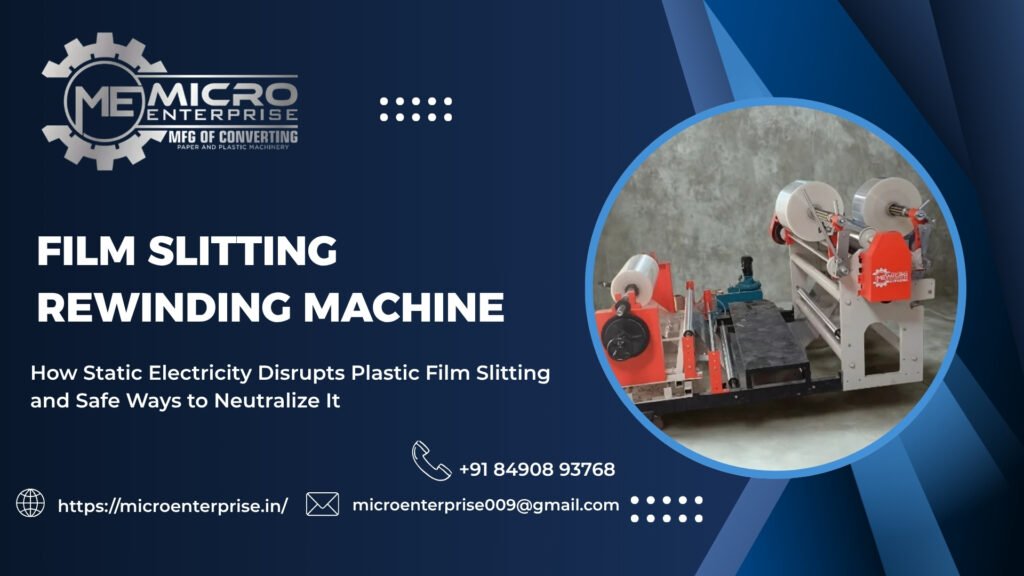
How Static Electricity Disrupts Plastic Film Slitting and Safe Ways to Neutralize It
If you operate a slitting rewinding machine processing plastic films like BOPP, PET, PE, or PVC, you have likely dealt with the invisible headache of static electricity. As plastic webs travel at high speeds across rollers, friction and separation generate massive electrostatic charges.
Left unchecked, static electricity does not just pose a safety hazard to your operators—it severely disrupts production, causing web wandering, dust attraction, erratic winding, and dangerous electrical sparks. Understanding how static charges accumulate and how to neutralize them is essential for maintaining smooth, high-speed converting lines.
Why Plastic Films Generate Static Charge
Plastics are excellent electrical insulators. When a film web moves through a machine, it constantly makes and breaks contact with various machine components, such as aluminium guide rollers, rubber sleeves, and slitting blades.
According to the triboelectric effect, friction between dissimilar materials transfers electrons. As the film peels away from a roller or passes through a BOPP film slitting rewinding machine, it retains an unbalanced electrical charge. Because the material cannot easily conduct electricity away, the voltage builds up rapidly—often reaching tens of thousands of volts in high-speed environments.
Operational Problems Caused by Static Buildup
Electrostatic charges create multiple production bottlenecks on the converting floor:
Web Misalignment and Sticking: Highly charged film webs act like magnets, clinging unpredictably to machine frames, guards, or adjacent layers. This causes tracking errors and edge wander.
Contamination and Dust Attraction: Static fields draw airborne dust, paper lint, and debris directly onto the film surface. When wound into a roll, this trapped debris creates permanent surface defects and pinholes.
Telescoping and Poor Roll Formation: Repulsive forces between heavily charged adjacent film layers prevent smooth stacking, leading to loose winding or edge telescoping.
Operator Safety Hazards: While rarely life-threatening, unexpected electrostatic shocks can startle operators working near unwinds, rewinds, or air shafts, potentially leading to hand injuries near moving webs.
Effective Methods to Neutralize Static in Slitting Lines
To keep your converting lines running efficiently and safely, implement these proven static control measures:
Install AC/DC Ionizing Bars: Place static eliminators (ionizing bars) strategically right before the slitting knives and immediately ahead of the rewind zone. These bars flood the air with positive and negative ions, instantly neutralizing the charge on the moving film surface.
Ensure Proper Machine Grounding: Verify that all metallic components—including cylinders shafts, line shafts, and frame assemblies—are securely grounded to earth. Ungrounded components act as capacitors, storing and releasing erratic charges.
Use Anti-Static Tinsel or Cord: As a passive, low-cost supplementary measure, install copper or carbon fiber tinsel bars that brush lightly against the web, providing a conductive path for static bleeding.
Maintain Plant Humidity: Extremely dry air accelerates static generation. Maintaining optimal relative humidity levels in your converting facility helps naturally dissipate surface charges.
Conclusion
Static electricity is an unavoidable physical phenomenon in plastic film processing, but it does not have to control your production line. By combining proper equipment grounding with advanced active ionization systems, you can eliminate static interference, protect your product quality, and ensure clean, high-speed conversions.
Next Steps for Your Plant: Looking to upgrade your plant’s converting efficiency? Explore our range of precision-engineered Slitting Rewinding Machines built with optimal grounding and web-handling architecture.
 Users Today : 7
 Users This Month : 87
 Total Users : 2876