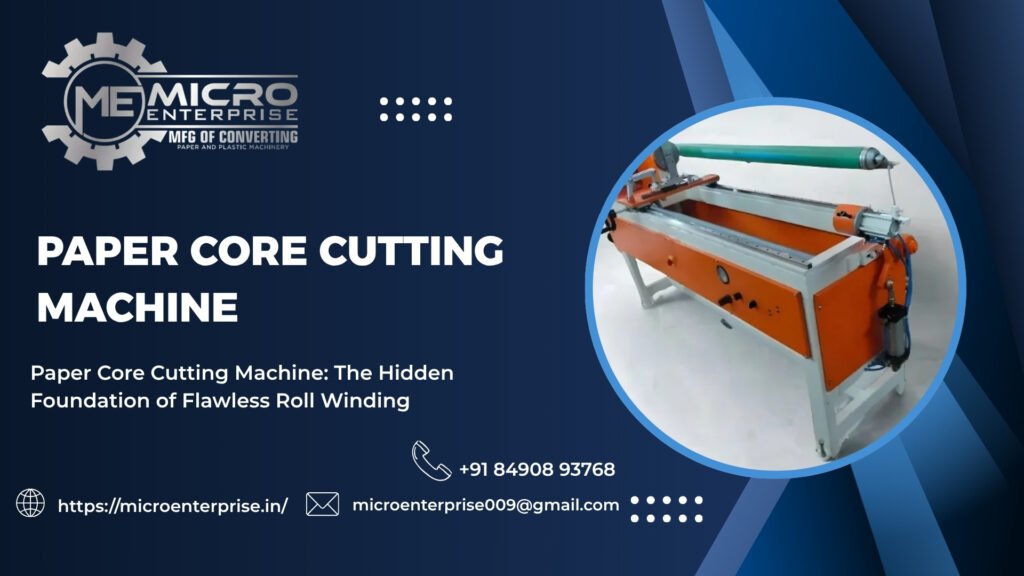
Paper Core Cutting Machine: The Hidden Foundation of Flawless Roll Winding
In the world of web converting, plant operators invest heavily in high-end slitting rewinding machines, advanced tension control systems, and precision rotary blades. Yet, despite having state-of-the-art machinery, converting lines occasionally suffer from telescoping rolls, winding vibrations, uneven edge density, or core slippage.
More often than not, the root cause of these issues isn’t found in the slitting zone—it is found in the preparation stage. If the paper or cardboard core tubes loaded onto your rewind shafts are unevenly cut, out-of-round, or burdened with ragged burrs, no amount of machine calibration can entirely fix the resulting winding defects. This is why a dedicated paper core cutting machine is an indispensable asset for any professional converting plant.
Why Core Quality Dictates Winding Success
When an individual slit lane is wound onto a core tube at high speeds (often exceeding 300 to 500 meters per minute), the core serves as the structural foundation of the finished roll. Poorly prepared cores introduce immediate mechanical complications:
Winding Vibration and Core Wobble: If a core is cut slightly out of square or has an uneven edge, it will wobble dynamically as the rewind shaft rotates at high RPMs, causing uneven strip tension and jagged roll edges.
Core Slip and Telescoping: Ragged or compressed inner walls prevent pneumatic air shafts or friction rings from gripping the core evenly, causing the core to spin inside the material layer and ruining roll geometry.
Internal Dust and Contamination: Manual sawing or crude cutting methods generate massive amounts of paper dust and cardboard fragments that get trapped inside the core and stick to the first few wraps of your product.
Key Features of a High-Performance Paper Core Cutting Machine
A modern industrial core cutter is engineered to deliver absolute precision, speed, and safety:
1. Rotary Blade Cutting Mechanism
Utilizing a sharp, motor-driven circular cutting blade that presses against or rotates through the paper tube, the machine slices clean through thick cardboard walls without crushing or distorting the tube’s outer diameter.
2. Accurate Length Positioning Gauges
Equipped with manual or automated length-stop measuring scales, operators can set precise cutting widths instantly, ensuring that every single core cut matches the exact width of your slitting layout down to the millimeter.
3. Heavy-Duty Support and Mandrels
Robust mechanical frames and secure clamping mandrels hold the master core tube firmly in place during the cut, preventing lateral shifting and guaranteeing a perfectly square, 90-degree edge.
Best Practices for Core Preparation
Keep Blades Sharp: Periodically inspect and sharpen your core cutter’s circular blade. A dull blade compresses and deforms the cardboard rather than slicing it cleanly.
Match Core Lengths Precisely: Ensure your cut core lengths match your slitting blade spacing exactly. Cores that are too wide cause crowding on the rewind shaft, while cores that are too narrow leave unsupported edges.
Integrate with Your Slitting Line: Position your paper core cutting machine close to your primary Slitting Rewinding Machine to streamline operator workflow and maintain a steady supply of ready-to-use cores.
Conclusion
A high-precision paper core cutting machine may be an auxiliary piece of equipment, but it plays a foundational role in safeguarding your finished product quality. By ensuring every core tube is square, clean, and exact in length, your plant eliminates core slip, prevents winding vibration, and guarantees professional roll geometry every time.
Explore Our Solutions: Ready to streamline your converting plant’s core preparation workflow? Explore our robust range of machinery and complementary equipment built for industrial precision and operational reliability.
 Users Today : 6
 Users This Month : 86
 Total Users : 2875