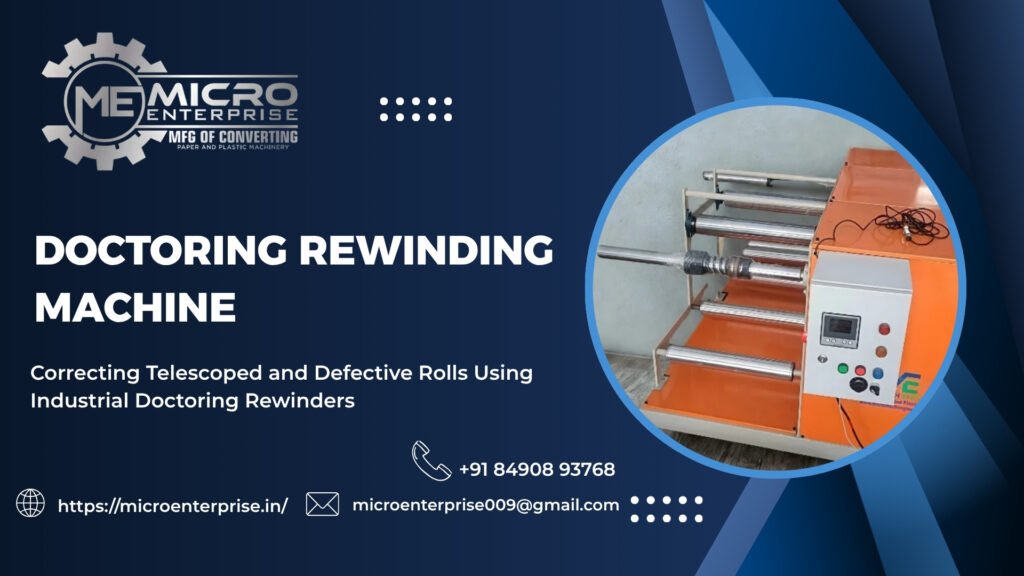
Correcting Telescoped and Defective Rolls Using Industrial Doctoring Rewinders
In primary film extrusion plants, flexible packaging converting facilities, commercial printing operations, and paper coating mills, winding defects periodically occur due to tension surges, sudden machine stops, or uneven parent web thickness. High-value printed, laminated, or coated rolls that exhibit edge misalignment, soft spots, inter-layer telescoping, or localized surface damage cannot be dispatched to end clients or processed on high-speed filling lines.
Restoring damaged substrate reels and recovering high-value converting materials depends fundamentally on the corrective engineering of an industrial Doctoring Rewinding Machine.
An industrial doctoring rewinder incorporates bi-directional reversible drive motors, high-precision web edge and center guide sensors, pneumatic lay-on rollers, tension-isolating dancer systems, optional edge-trim slitting knives, and ergonomic splicing tables designed for roll repair.
Scrapping defectively wound rolls or attempting to run telescoped reels on high-speed packaging equipment leads to massive material financial losses, severe web jams, equipment downtime, print registration errors, and customer rejections. Understanding the core theoretical mechanics governing bi-directional web transport, dynamic web edge positioning, tension neutralization, and inter-layer air purging enables converting engineers to salvage defective rolls efficiently. This comprehensive technical guide provides an in-depth theoretical analysis of correcting telescoped and defective rolls using industrial doctoring rewinders.
Theoretical Dynamics of Roll Salvaging and Re-Spooling Kinetics
Doctoring rewinders operate as dedicated web restoration systems that unroll, realign, tension-correct, and rewiring defective reels back into perfect commercial specifications:
+-----------------------------------------------------------------+
|                   DEFECTIVE OR TELESCOPED ROLL UNWIND           |
| (Misaligned, soft, or telescoped roll enters doctoring station) |
+-----------------------------------------------------------------+
                                  |
                                  v
+-----------------------------------------------------------------+
|             DYNAMIC WEB EDGE ALIGNMENT & TENSION EQUALIZATION   |
| (Web guide sensors continuously track & correct web position)   |
+-----------------------------------------------------------------+
                                  |
                                  v
+-----------------------------------------------------------------+
|             BI-DIRECTIONAL RE-SPOOLING & HIGH-DENSITY REWIND    |
| (Re-spooling purges trapped air & forms perfectly aligned roll) |
+-----------------------------------------------------------------+
1. Bi-Directional Re-Spooling Mechanics and Tension Isolation
Theoretical Principle: Doctoring rewinders utilize reversible bi-directional drives that allow web travel in both forward and reverse directions. This capability enables operators to rewind a damaged section, unwind backward to locate internal defects, remove flawed substrate segments, and re-spool the roll smoothly.
Tension Equalization: By isolating unwind tension from rewind tension through low-inertia dancer assemblies, doctoring machines relieve locked-in mechanical stress profiles present in poorly wound rolls, preventing web stretching while building uniform internal density.
2. Dynamic Web Edge Tracking and Telescoping Realignment
Theoretical Principle: Roll telescoping occurs when adjacent web wraps slide laterally due to trapped boundary layer air and uncontrolled winding tension. Correcting a telescoped roll requires running the substrate across an active web guiding system before rewinding.
Electro-Hydraulic Guide Correction: High-resolution optical or ultrasonic sensors track the moving web edge continuously, signaling electro-hydraulic actuators to shift the unwind stand axially. This active realignment forces misaligned web edges back into a precise linear plane, converting staggered, telescoped rolls into perfectly straight-sided output coils.
Comprehensive Analysis of Doctoring and Salvaging Features
Integrating an industrial doctoring rewinder into converting operations enables comprehensive roll recovery across several key scenarios:
Correction of Soft or Spongy Winding Hardness: Re-spooling loose rolls under controlled tension while applying pneumatic lay-on nip pressure purges entrained air pockets, increasing internal roll hardness to meet strict delivery standards.
Edge-Trim Slitting and Edge Damage Removal: Incorporating razor or shear slitting knives allows doctoring stations to trim nicked, crushed, or torn web edges during the re-spooling process, restoring pristine edge geometry.
Defect Splicing and Waste Segment Elimination: Integrated vacuum splicing tables with pneumatic clamps allow operators to cut out printed flaws, coating streaks, or pinhole sections and execute clean web splices without disturbing total roll alignment.
Reverse Printing Direction Realignment: When printed rolls are delivered wound in the incorrect unwind orientation for customer filling machinery, doctoring rewinders flip the winding direction cleanly without compromising surface quality.
System Integration Across Converting Machinery Infrastructure
Doctoring rewinders function as essential material recovery units within comprehensive material converting plants:
Dedicated Corrective Roll Salvaging: Precision re-spooling, web edge realignment, and defect repair are executed on an advanced Doctoring Rewinding Machine.
General Substrate Converting: Universal high-speed slitting and tension control across flexible substrates are handled on a Slitting Rewinding Machine.
Paper Reel Converting: Precision paper reel slitting and roll density control are handled on a heavy-duty Paper Slitting Rewinding Machine.
Metallic Foil Processing: Precision thin aluminum foil slitting with anti-static control is executed on a specialized Foil Rewinding Machine.
Flexible Film Converting: Tension-sensitive BOPP and PET film slitting without stretching is managed on a BOPP Film Slitting Rewinding Machine.
Heavy Woven Fabric Slitting: Industrial synthetic fabric edge trimming is achieved on a robust HDPE Fabric Slitting Rewinding Machine.
Quality Inspection & Defect Mapping: High-speed optical defect detection and web surface quality mapping are integrated into an Inspection Rewinding Machine.
Economical Single Shaft Winding: Simple, compact narrow web winding on a single mandrel is performed on a Single Shaft Slitting Rewinding Machine.
Surface Drive Roll Formation: Large-diameter roll formation driven by uniform contact nip pressure is achieved using a Surface Slitting Rewinding Machine.
Multi-Motor Heavy Roll Systems: Large jumbo roll management with independent drive motors is handled on a 3 Drive Drum Type Slitting Rewinding Machine.
Cantilever Ergonomic Handling: Rapid core loading and cantilever arm swing-out operations are enabled by a Cantilever Slitting Rewinding Machine.
Continuous Trim Management: Continuous online edge scrap collection and compact winding are executed using a heavy-duty Trim Winder Machine.
Theoretical Best Practices for Doctoring Rewinder Operation
o ensure maximum roll recovery rates, prevent web stretching during salvaging, and optimize re-spooling quality, converting engineers follow three core theoretical guidelines:
Utilize Low-Inertia Carbon Fiber Guide Rollers: Specify ultra-lightweight guide rollers on doctoring machines to minimize friction drag and web momentum during rapid bi-directional reversals.
Deploy Dual Ultrasonic Edge and Center Line Sensors: Utilize dual ultrasonic web guide sensors capable of tracking both opaque webs and transparent barrier films accurately, maintaining precise web alignment.
Program Soft-Start and Smooth Deceleration Curves: Configure motor drive acceleration and deceleration ramps to prevent dynamic tension spikes when reversing or stopping the web to inspect flaws.
Conclusion
Understanding the theoretical mechanics of bi-directional re-spooling kinetics, dynamic web edge tracking, tension equalization, and inter-layer air expulsion is essential for correcting telescoped and defective rolls using doctoring rewinders. By deploying active web guiding systems, utilizing bi-directional servo drives, incorporating edge-trim slitting, and managing rewinding tension profiles, converting facilities salvage high-value defective reels, eliminate scrap waste, and maintain exceptional finished product quality.
Looking for High-Performance Doctoring and Roll Salvaging Machinery? Explore our complete range of corrective Doctoring Rewinding Machine stations, high-speed Slitting Rewinding Machine units, heavy-duty Paper Slitting Rewinding Machine setups, specialized Foil Rewinding Machine setups, sensitive BOPP Film Slitting Rewinding Machine lines, industrial HDPE Fabric Slitting Rewinding Machine systems, advanced Inspection Rewinding Machine setups, compact Single Shaft Slitting Rewinding Machine models, heavy Surface Slitting Rewinding Machine lines, multi-motor 3 Drive Drum Type Slitting Rewinding Machine systems, ergonomic Cantilever Slitting Rewinding Machine units, and continuous Trim Winder Machine setups at Micro Enterprise. Contact our expert engineering team today.
 Users Today : 11
 Users This Month : 301
 Total Users : 3424