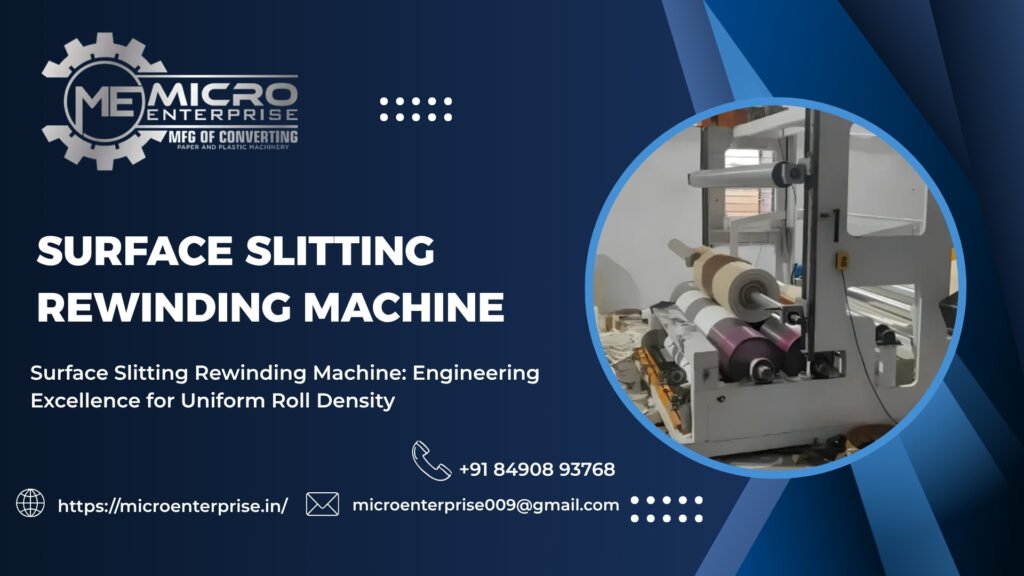
Surface Slitting Rewinding Machine: Engineering Excellence for Uniform Roll Density
In the world of web converting, choosing the right winding architecture is just as important as selecting the right slitting knives. While center-driven winders apply torque directly to the core shaft, many industrial applications—such as high-speed paper manufacturing, non-woven textiles, and wide-web packaging materials—require a different mechanical approach.
A specialized Surface Slitting Rewinding Machine drives the finished roll from its outer circumference via contact with one or more rotating steel or rubber-covered drums. This surface-driven mechanics changes how winding pressure and tension behave across the entire roll diameter. Let’s examine the engineering advantages and key operational features of surface winding systems.
How Surface Winding Works and Why It Matters
In a Surface Slitting Rewinding Machine, the primary winding force is delivered directly at the nip point where the growing roll touches the driven support drum.
Direct Energy Transfer: Because torque is applied at the outer surface rather than transmitted inward through every preceding layer of material, internal roll pressure remains remarkably uniform.
Superior Air Expulsion: As the material wraps around the nip point, the physical weight and drum pressure squeeze trapped boundary air out from between the layers before they are locked into the roll. This prevents telescoping, softness, and core slippage.
Key Features of an Industrial Surface Slitting Rewinding Machine
A high-performance surface slitting and rewinding line is equipped with robust engineering features designed for heavy-duty industrial environments:
1. Precision-Driven Contact Drums
The heart of the machine is its heavy-duty contact drums (often paired with specialized rubber rollers or grooved cylinders). These dynamically balanced drums ensure smooth, vibration-free speed synchronization with the incoming web path.
2. Advanced Slitting and Edge Trim Management
Before the webs reach the surface winding drums, the material passes through precise cutting zones. Whether utilizing rotary shear knives or razor assemblies mounted securely on rigid air shafts, the machine delivers clean, dust-free strip separation.
3. Closed-Loop Tension and Nip Load Regulation
Managing contact pressure between the winding roll and the drive drum is critical. Integrated pneumatic cylinders controlled by a responsive power pack ensure that nip pressure tapers down intelligently as the roll diameter builds, protecting inner layers from excessive crushing.
4. Stable Unwind and Web Guidance
To prevent lateral wandering before surface contact, the incoming web is stabilized by lightweight aluminium guide rollers with low starting inertia, working in tandem with optical edge-guiding sensors.
Key Technical Specifications to Consider
| Technical Parameter | Industrial Specification for Surface Rewinding |
| Substrate Compatibility | Paper, Non-Wovens, Heavy Films, Textiles, Foils |
| Max Working Speed | 300 to 800+ meters per minute |
| Winding Architecture | Single or Multiple Drum Surface Contact Drive |
| Core Securing | Pneumatic air shafts / Mechanical chucks |
| Core Preparation | Cut precisely using a dedicated paper core cutting machine |
Best Practices for Surface Rewinding Operations
Monitor Drum Wear Regularly: Inspect the surfaces of your drive drums and rubber-covered rollers periodically. Any surface wear, gouges, or adhesive buildup will transfer imperfections directly onto the wound material.
Calibrate Nip Pressure Curves: Ensure your pneumatic loading system is properly programmed to reduce pressure as roll weight increases, preventing core distortion or internal bursting.
Keep Core Quality High: Always use clean, perfectly round core tubes prepared on an automated paper core cutting machine to ensure smooth engagement across the surface drive shafts.
Conclusion
A Surface Slitting Rewinding Machine offers unmatched advantages for converters processing high-speed, air-entrapment-prone, or heavy industrial webs. By delivering winding power directly at the outer circumference, these machines guarantee exceptional roll hardness and structural integrity.
Explore Our Solutions: Ready to upgrade your facility with robust surface-winding technology? Explore our advanced range of Slitting Rewinding Machines engineered for high-speed industrial stability and superior finished roll density.
 Users Today : 7
 Users This Month : 87
 Total Users : 2876